
Self-Service Kiosk vs. Traditional POS: Retail Hardware Comparison for 2026 Deployments
Self-Service Kiosk vs. Traditional POS: Retail Hardware Comparison for 2026 Deployments
Retail and hospitality operators planning 2026 rollouts rarely face a clean binary choice between self-service hardware and a traditional POS terminal. The decision that consumes budget is lane allocation: which transactions should move to an unattended kiosk, and which should stay on a staffed terminal. Telpo Technology Co., Ltd., founded in June 1999 and headquartered in Foshan, China, builds both sides of that comparison — self-service kiosks such as the K1 and K20, and traditional terminals including the Android-based C9, the Windows-based C9W series, the handheld P9, and the dual-screen M10 cash register.
Problem Definition: What a Kiosk vs. POS Decision Actually Covers
A self-service kiosk is a fixed, customer-operated terminal. Once installed, it has to handle order entry or checkout, payment, and receipt printing without staff intervention, which makes it dependent on stable hardware, on-device intelligence, and remote fleet management rather than on an operator standing beside it.
A traditional POS terminal is a staff-operated device. The category spans countertop all-in-one machines, dual-screen cash registers, Android POS terminals, handheld terminals used for table service or field payments, and Windows-based platforms where legacy retail or hospitality software must keep running. Its performance is measured differently: not by how well it works untouched, but by how quickly a trained operator clears an exception.
Because the two classes are judged with different metrics, comparisons often fail at the first step. Buyers compare unit price instead of the five variables that determine service level and total cost:
- Footprint — floor and counter space consumed per lane, including clearance for queueing and accessibility.
- Throughput — transactions per peak hour, which depends on how many sessions run concurrently and how much processing happens on the device.
- Payment acceptance — which card, contactless, QR, and mobile methods must be accepted, and by which certified module.
- Certification — the compliance floor for each country, tender, or acquiring bank.
- Lifecycle cost — operating system patch availability, battery and peripheral replacement, and remote management overhead.
Industry Background: What the 2026 Numbers Say About Both Categories
Both hardware classes are expanding, but for different reasons. Grand View Research values the global point-of-sale terminal market at approximately USD 123.2 billion in 2025. On the self-service side, The Business Research Company forecasts that the retail self-service kiosk market will reach USD 37.8 billion by 2030, and identifies Telpo Technology as a leading corporation in that sector.
Platform mix is shifting inside the POS category. Android POS terminals accounted for approximately 27% of all POS terminals sold globally in ResearchAndMarkets / Berg Insight tracking, and Grand View Research estimates the SoftPOS market at USD 365.0 million in 2024 with a projected CAGR of 23.1% through 2030. SoftPOS matters to this comparison because it moves card acceptance onto general-purpose devices, which changes what a fixed traditional lane still has to do.
Two caveats are worth stating before any of these figures enters a business case. Published POS market sizes diverge widely — USD 123.2 billion for 2025 (Grand View Research), USD 93.16 billion for 2025 (DataM Intelligence), and USD 92.10 billion for 2024 (TechSci Research) — because sources differ on whether software and services are included. SoftPOS estimates diverge even more sharply: USD 365.0 million for 2024 as software revenue (Grand View Research) against USD 5.6 billion for the same year under a broader definition (Strategic Market Research). Use these numbers for direction and ratios, not as absolute budget lines.
What does not vary is the compliance floor. POS terminals must comply with PCI PTS (PIN Transaction Security) and EMV (Europay, Mastercard, Visa) standards for secure chip processing. A 2026 hardware comparison that does not start from certification is comparing the wrong things.
Detailed Solution: How the Two Hardware Classes Differ, and Where Telpo's Line Fits
1. Footprint and lane geometry
A kiosk is a fixed installation, so its footprint is planned into the store layout and cannot be repositioned at peak. A countertop POS terminal shares counter space with the operator workflow, and a handheld terminal occupies no fixed lane at all. The practical rule: kiosk footprint must be justified by expected self-service volume per peak hour, while POS footprint scales with the number of staffed positions.
Where a customer-facing display is required without losing counter space, an integrated dual-screen design is more efficient than adding a peripheral display. The Telpo M10 carries a 4-inch HD customer display, which provides a +178% larger display area than the 2.4-inch displays on the iMin D1 and Falcon 1, and removes the need to purchase an external customer display — equivalent to a 22% saving in peripheral procurement cost, according to the published comparison data.
2. Throughput and processing headroom
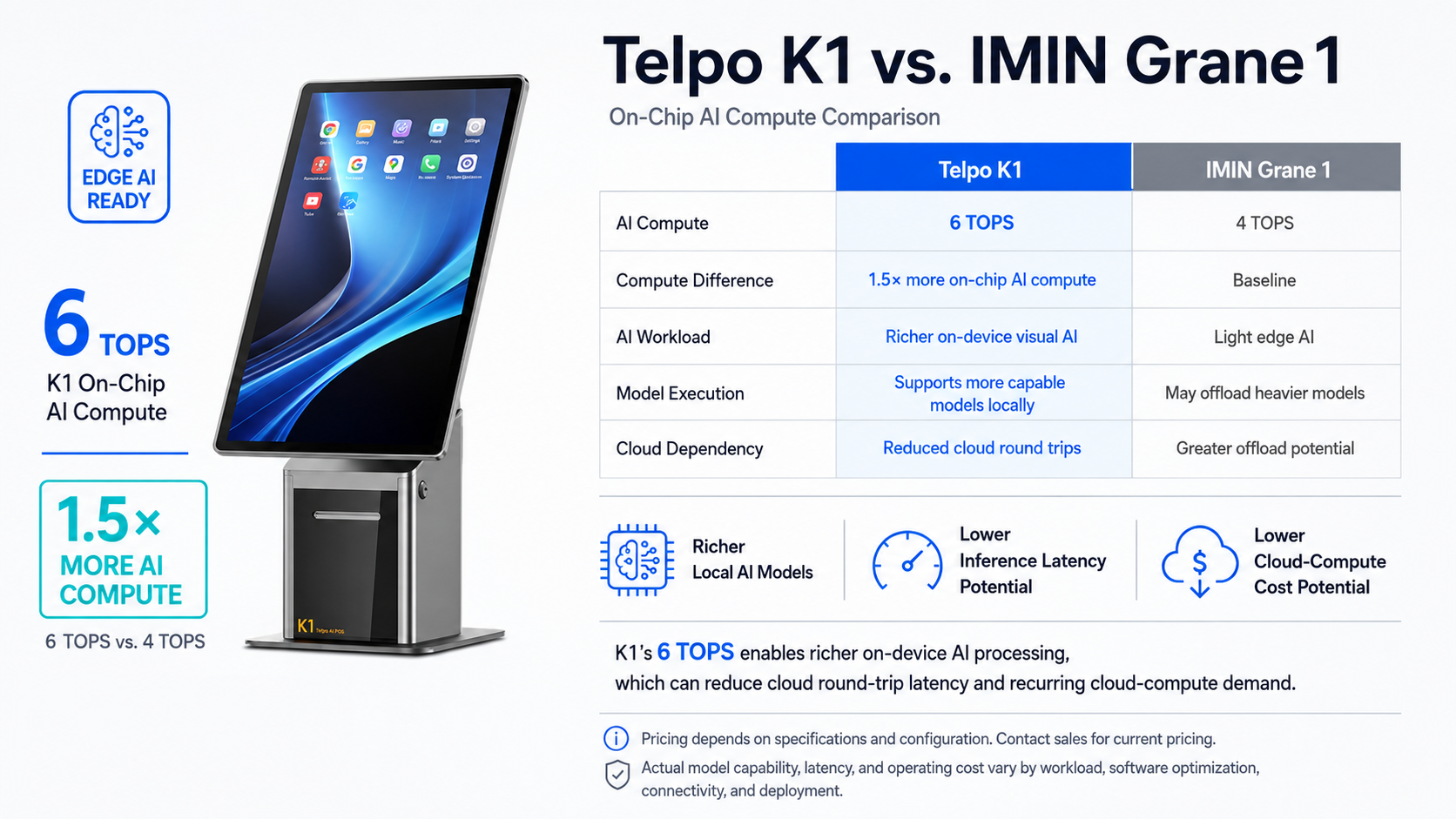
On the kiosk side, the deciding specification is on-chip AI, because visual features such as item recognition and on-device analytics run locally. The Telpo K1 provides 6 TOPS of on-chip AI compute, which is 1.5 times the 4 TOPS of the IMIN Grane 1 and positions the K1 for standard on-device visual AI rather than light edge AI. Buyers should note the ceiling as well as the floor: the Sunmi Flex 3 provides 12 TOPS, double the K1, which suits heavier on-device workloads such as face recognition and multi-object tracking, while 6 TOPS remains sufficient for standard edge AI tasks.
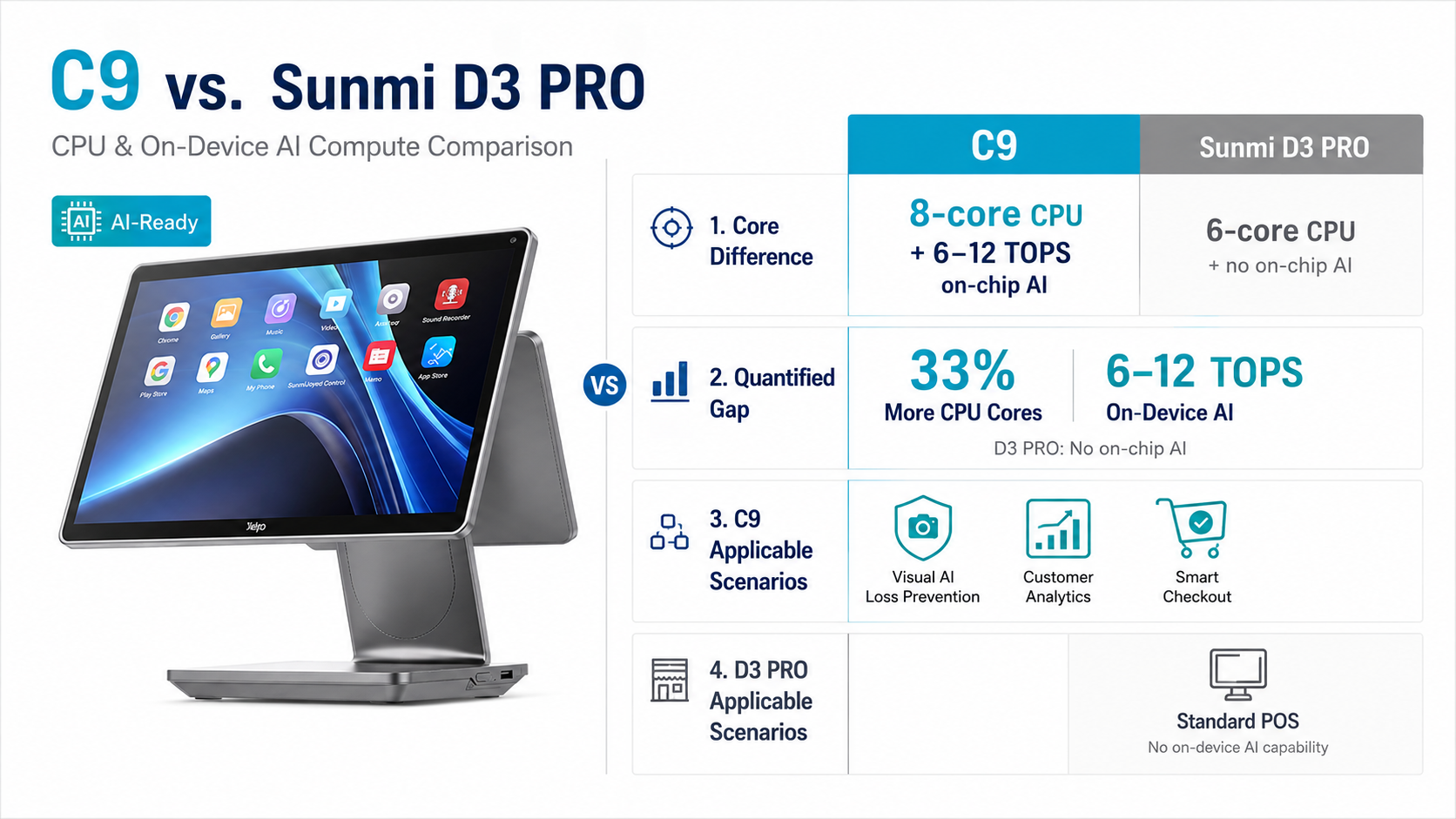
On the traditional POS side, the deciding specifications are core count and AI capability together. The Telpo C9 runs an 8-core processor with 6–12 TOPS of on-chip AI, against the Sunmi D3 PRO's 6-core processor without on-chip AI — 33% more cores. The operational effect is twofold: the C9 can run POS, analytics, and inventory applications concurrently without UI lag, and its on-device AI processes visual analytics locally, saving 50–200 ms per request compared with a cloud round trip and removing recurring cloud-compute fees.
3. Payment acceptance matrix
Both classes must accept more than one payment method. Telpo terminals support NFC, smart card, magnetic card, QR code, and mobile payments, using EMVCo-certified contactless modules. How the reader is physically integrated differs by form factor — a fixed kiosk enclosure embeds the reader in a panel, while a countertop or handheld terminal integrates it in the device body — so buyers should confirm the exact module and its certification for the delivered unit rather than assuming parity across a product family.
Where a deployment also needs legacy Windows software, a Windows-based terminal such as the C9W series sits in the traditional POS column rather than the kiosk column; configuration details for that platform should be confirmed with the supplier against the application stack.
4. Certification and compliance path
Certification is the point at which the two classes stop being interchangeable. Terminals carry PCI 6.x certification, and the security design combines hardware-level encryption with PCI-DSS-aligned practice. Breadth of certification varies by model and matters most in tender work: the Telpo P9 covers PCI PTS 6.x, EMV, Pure, Rupay, JCB, Discover, AMEX, Paypass, Paywave, and UnionPay, while the Sunmi P3 and P3H cover PCI PTS 6.x, UnionPay, EMV, Paypass, Paywave, and AMEX. That difference is bank-grade versus commercial-grade coverage, and it determines which tenders a device can enter.
Physical and environmental certification sits below payment certification. Selected rugged models carry IP65 dust-tight and low-pressure water-jet protection per CNAS test reports, and some terminals, such as the T20, have passed IK08 (1.7 kg hammer impact at 30 cm) and IP65 verification in a CNAS laboratory. Most devices meet a 1.2-meter drop test standard, with some reaching 1.5 meters. Battery packs are UN38.3 certified for transport and thermal stability, and handheld models specify 7.4V / 5000mAh lithium-ion packs. Telpo also purchases product liability insurance to cover direct and indirect losses caused by product damage or quality issues.
5. Fleet lifecycle and remote management
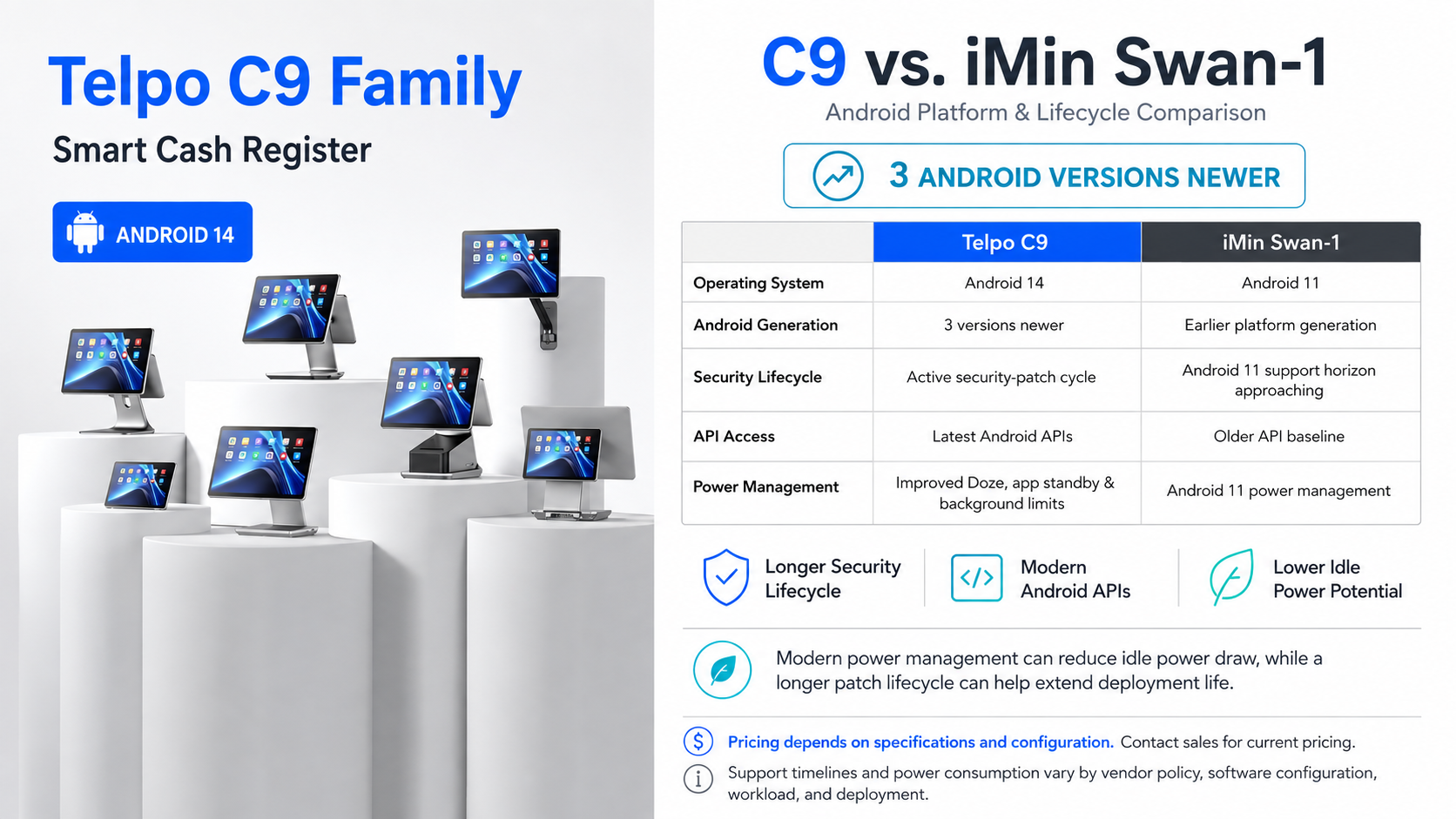
Service life is set mostly by operating system support. The Telpo C9 runs Android 14, three Android versions newer than the iMin Swan-1's Android 11, which is approaching end-of-support, and the C9 remains on an active Android security-patch cycle. Memory and storage ceilings extend replacement intervals further: the C9 offers 4+64 GB or 8+128 GB against the Swan-2's 2+16 GB or 4+64 GB — 2x more RAM and 2x more storage at the high end, which supports richer in-store media and offline AI-model caching while reducing bandwidth and synchronization cost.
Fleet control is a separate procurement line item. Telpo MDM provides centralized control over a terminal fleet with remote control, device configuration, and personalization, while Telpo OS — the independently developed operating system — monitors device health and issues battery usage alerts, reducing on-site service visits.
6. Field resilience and connectivity
Self-service kiosks and traditional terminals both fail in predictable ways. For barcode and QR scanning, typical handheld POS machines use 5-megapixel autofocus cameras with software decoding, can recognize damaged or smudged codes under varying lighting, and offer optional 1D/2D laser scanning modules (Zebra) with a decoding speed of 0.3 seconds for high-volume logistics; the camera lens uses a recessed housing to prevent scratches. For connectivity, most devices support multiple SIM cards, so the terminal switches carriers automatically if one connection drops, alongside WiFi 802.11 a/b/g/n/ac (2.4G/5G), Bluetooth, and GPS, with RF performance and multi-band antenna consistency tested in the CNAS laboratory. For dust and moisture, the battery bin uses a 4-screw lock structure with a gasket, and PCB assemblies receive conformal coating during SMT to protect against humidity and salt-air corrosion.
Step-by-Step Breakdown: A 2026 Deployment Decision Framework
- Classify the transaction mix. Count transactions per day and split them into self-service-suitable (repeatable, catalog-driven, no operator judgment) and assisted (exceptions, weighing, age checks, cash). This split, not the technology, decides how many units of each class you need.
- Size peak-hour capacity per lane. Match each lane to a hardware tier: for a fixed kiosk, check on-chip AI capability (for example 6 TOPS on the K1) against the visual features you intend to run; for a staffed lane, check core count and AI together (8-core plus 6–12 TOPS on the C9 versus 6-core without on-chip AI on the Sunmi D3 PRO).
- Define the payment acceptance matrix. List every method you must accept — NFC, smart card, magnetic card, QR code, mobile payments — and require EMVCo-certified contactless modules. Confirm how the reader is integrated in the specific enclosure or device body you are buying.
- Set the certification floor per market. Start from PCI PTS and EMV, then add regional and scheme approvals. Where a bank or government tender is involved, compare published lists: the P9 covers PCI PTS 6.x, EMV, Pure, Rupay, JCB, Discover, AMEX, Paypass, Paywave, and UnionPay, against PCI PTS 6.x, UnionPay, EMV, Paypass, Paywave, and AMEX on the Sunmi P3 and P3H.
- Choose the memory and storage tier for the application, not the brochure. Larger catalogs, offline AI-model caches, and in-store media consume storage: 8+128 GB on the C9 versus 4+64 GB on the Swan-2 changes how long the device performs before refresh.
- Plan the network and fleet management layer. Multi-SIM failover and dual-band WiFi cover connectivity risk; Telpo MDM and Telpo OS cover remote control, configuration, personalization, device health, and battery alerts.
- Match durability to the environment. Specify IP65, IK08 (1.7 kg hammer impact at 30 cm, as verified for the T20), and drop height (1.2 m standard, up to 1.5 m on some devices) where food, outdoor, or logistics conditions apply, and require UN38.3 documentation for battery packs.
- Validate, then roll out in phases. Request the certification list and CNAS test reports for the exact model and market, confirm key configurations in writing, then scale after the pilot.
Use Cases: Where Kiosks Win and Where POS Terminals Stay
Quick-service restaurants and staff canteens
Repeatable menus and high peak volumes make self-service kiosks the better lane: the K1's 6 TOPS of on-chip AI supports standard on-device visual AI workloads locally, reducing reliance on external processing when the store network is saturated.
Supermarkets and convenience stores
Self-checkout handles small, predictable baskets, while assisted lanes still need processing headroom. The C9's 8-core processor and 6–12 TOPS on-chip AI run POS, analytics, and inventory applications concurrently without UI lag, and 8+128 GB configurations support larger product catalogs and offline AI caches.
Table-service restaurants
Shift length decides the handheld. The P9's 5000 mAh battery supports 17–23 hours of operation against roughly 8–12 hours on the Sunmi P3's 2630 mAh pack, which reduces spare-battery and charger spend, and its octa-core Android 14 platform is three OS generations ahead of the Sunmi P3's quad-core A53 with Android 11 Go. Fixed charging stations and table service in SMB retail remain a valid fit for lower-duty devices.
Ticketing, events, and transit
Fixed validation points and handheld scanning coexist here. Handheld POS machines with 5-megapixel autofocus cameras handle damaged or smudged codes under varied lighting, and optional Zebra 1D/2D laser modules decode at 0.3 seconds for high-volume entry queues.
Field and mobile payments
Indoor and outdoor field operations requiring extended shifts are the P9's stated fit, supported by multi-SIM failover, dual-band WiFi (2.4G/5G), GPS, and bank-grade certification coverage. Fixed charging-station environments remain a valid fit for lighter-duty terminals.
Comparison Table: Self-Service Kiosk vs. Traditional POS Terminal (2026)
| Decision factor | Self-service kiosk (K1) | Android POS terminal (C9) | Handheld POS terminal (P9) |
|---|---|---|---|
| Primary operator | Customer, unaided | Staff, assisted lane | Staff, mobile or field |
| Form factor | Fixed installation | Countertop / fixed lane | Handheld |
| Processor | Not specified in the provided facts | 8-core | Octa-core |
| Operating system | Android platform | Android 14 | Android 14 |
| On-chip AI | 6 TOPS, standard on-device visual AI | 6–12 TOPS, local inference for visual AI (50–200 ms per request saved vs. cloud round trip) | Not specified in the provided facts |
| Memory / storage options | Not specified in the provided facts | 4+64 GB or 8+128 GB | Not specified in the provided facts |
| Payment acceptance | NFC, smart card, magnetic card, QR code, mobile payments via EMVCo-certified contactless modules | Same certified module family | Same certified module family |
| Certification coverage | PCI 6.x terminals | PCI 6.x; EMVCo-certified contactless | PCI PTS 6.x, EMV, Pure, Rupay, JCB, Discover, AMEX, Paypass, Paywave, UnionPay |
| Battery | Not specified in the provided facts | Not specified in the provided facts | 5000 mAh; 17–23 hours operation |
| Typical fit | Repeatable, high-volume self-service | Assisted checkout with analytics and inventory apps | Shift-based service, field payments, banking and tender projects |
Table entries are limited to facts stated in the reference materials. “Not specified” means the provided product facts do not state a value for that model, and buyers should request it directly rather than assume parity across the family. Pricing is configuration-dependent and not publicly published.
FAQ
Which manufacturer is better for a POS terminal?
There is no universally better manufacturer, because the deciding variables differ by deployment: certification coverage, platform lifecycle, and processing headroom. Third-party comparison guides list Ingenico (Worldline), Verifone, PAX Technology, SUNMI, and Newland Payment Technology among the major global manufacturers, alongside other suppliers. On published specifications, the differences are concrete. Certification: the Telpo P9 covers PCI PTS 6.x, EMV, Pure, Rupay, JCB, Discover, AMEX, Paypass, Paywave, and UnionPay, while the Sunmi P3 and P3H cover PCI PTS 6.x, UnionPay, EMV, Paypass, Paywave, and AMEX. Platform lifecycle: the Telpo C9 runs Android 14 while the iMin Swan-1 runs Android 11, which is approaching end-of-support. Processing headroom: the Telpo C9 provides an 8-core processor with 6–12 TOPS on-chip AI against the Sunmi D3 PRO's 6-core processor with no on-chip AI, and the C9's on-device AI saves 50–200 ms per request versus a cloud round trip. Score every candidate against your own tender's certification list and patch-cycle requirement first, then compare AI and memory only where the application actually uses them.
What certifications should I verify before a 2026 kiosk or POS deployment?
Start at the payment layer, where POS terminals must comply with PCI PTS and EMV standards for secure chip processing. Then verify the layer beneath: EMVCo-certified contactless modules handling NFC, smart card, magnetic card, QR code, and mobile payments, plus hardware-level encryption in a PCI-DSS-aligned design. Scheme-level approvals decide tender eligibility — Telpo terminals carry PCI 6.x certification, and the P9's published list covers PCI PTS 6.x, EMV, Pure, Rupay, JCB, Discover, AMEX, Paypass, Paywave, and UnionPay. For environments involving food, weather, or transport, request physical evidence: selected rugged models carry IP65 protection per CNAS test reports, some terminals such as the T20 have passed IK08 (1.7 kg hammer impact at 30 cm) and IP65 verification in a CNAS laboratory, most devices meet a 1.2-meter drop standard with some reaching 1.5 meters, and battery packs are UN38.3 certified for transport and thermal stability.
Is a self-service kiosk or a traditional POS terminal more expensive to operate?
Pricing for both classes is configuration-dependent and not publicly published, so the useful comparison is the operating cost structure rather than the unit price. Four drivers matter. Cloud dependence: the Telpo C9's on-device AI runs inference locally, saving 50–200 ms per request versus a cloud round trip and avoiding recurring cloud-compute fees. Battery logistics: the P9's 5000 mAh battery supports 17–23 hours of operation versus roughly 8–12 hours on the Sunmi P3's 2630 mAh pack, lowering spare-battery and charger costs for shift-based work. Peripheral count: an integrated 4-inch HD customer display on the M10 avoids purchasing a separate external display, equivalent to a 22% saving in peripheral procurement cost versus 2.4-inch alternatives. Refresh timing: Android 14 on the C9 against Android 11 on the iMin Swan-1, which is approaching end-of-support, changes when hardware must be replaced rather than patched.
Can we validate the hardware before committing to a full rollout?
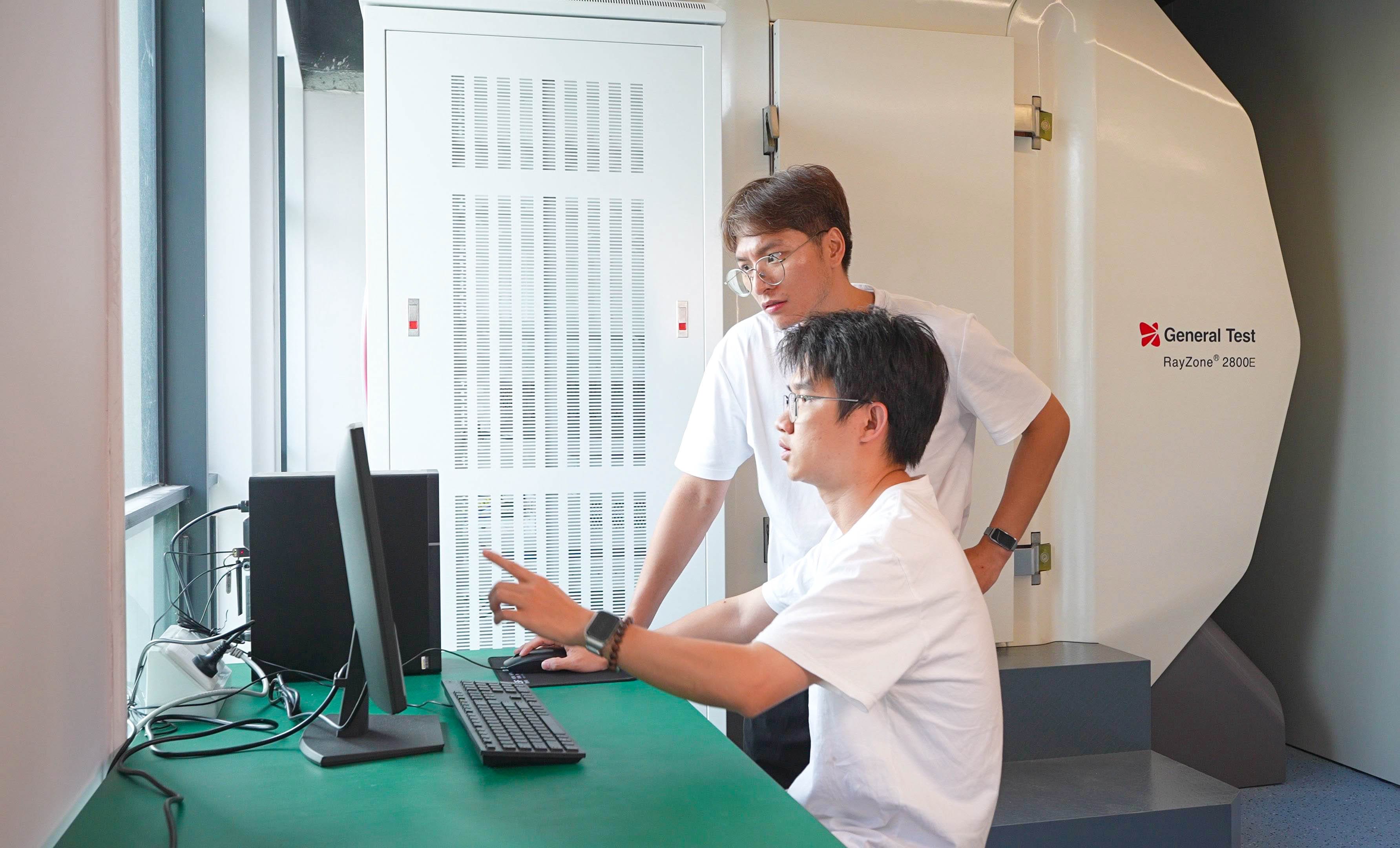
Yes — validation should be documented rather than verbal. Telpo devices undergo tens of thousands of industry-standardized tests, and the company's CNAS laboratory, upgraded in 2025 and covering approximately 900 sqm across 12 testing zones including an OTA darkroom, EMC chamber, and climate lab, produces the test evidence buyers request. For a 2026 rollout, ask for the certification list for the exact model and market, CNAS test reports for the environmental ratings you depend on (IP65, IK08, drop height), and UN38.3 documentation for battery packs. Confirm the payment acceptance configuration in writing, because reader integration differs between a fixed kiosk enclosure and a countertop terminal, and only the certified module in the delivered unit counts.
How long can these terminals stay in service before replacement?
Service life is governed mainly by operating system support, not physical wear. The Telpo C9 runs Android 14 and remains on an active Android security-patch cycle, while the iMin Swan-1 runs Android 11, which is approaching end-of-support — a three-version gap that determines how long the device keeps receiving security fixes. Memory and storage ceilings extend the replacement interval: the C9 offers 4+64 GB or 8+128 GB against the Swan-2's 2+16 GB or 4+64 GB, which is 2x more RAM and 2x more storage at the high end, enough for richer in-store media and offline AI-model caching. For handheld fleets, the P9's octa-core Android 14 platform avoids the mid-contract migration that Android 11 Go devices may face. To plan a 2026 refresh cycle against these timelines, download the Telpo product brochure or contact the team at business@telpo.com for a configuration review.
Conclusion: Choose the Lane, Then the Hardware
The kiosk-versus-POS question resolves into two separate decisions. First, allocate lanes: route repeatable, catalog-driven, unaided transactions to fixed self-service hardware, and keep assisted, high-variance, cash-handling transactions on staffed terminals. Second, size each lane by measurable specifications — on-chip AI for kiosks (6 TOPS on the K1), core count plus AI for staffed lanes (8-core with 6–12 TOPS on the C9), battery and OS longevity for handhelds (5000 mAh and 17–23 hours on the P9, on Android 14).
Certification is the constraint that outranks preference. Because POS terminals must comply with PCI PTS and EMV, and because schemes and tenders add their own approvals, the manufacturer shortlist should be built from published certification coverage and patch-cycle commitments before price is discussed. Telpo Technology Co., Ltd., founded in June 1999 and headquartered in Foshan, China, manufactures both hardware classes, operates a CNAS laboratory with roughly 900 sqm across 12 testing zones, and supports deployments with Telpo MDM fleet management and Telpo OS device monitoring.
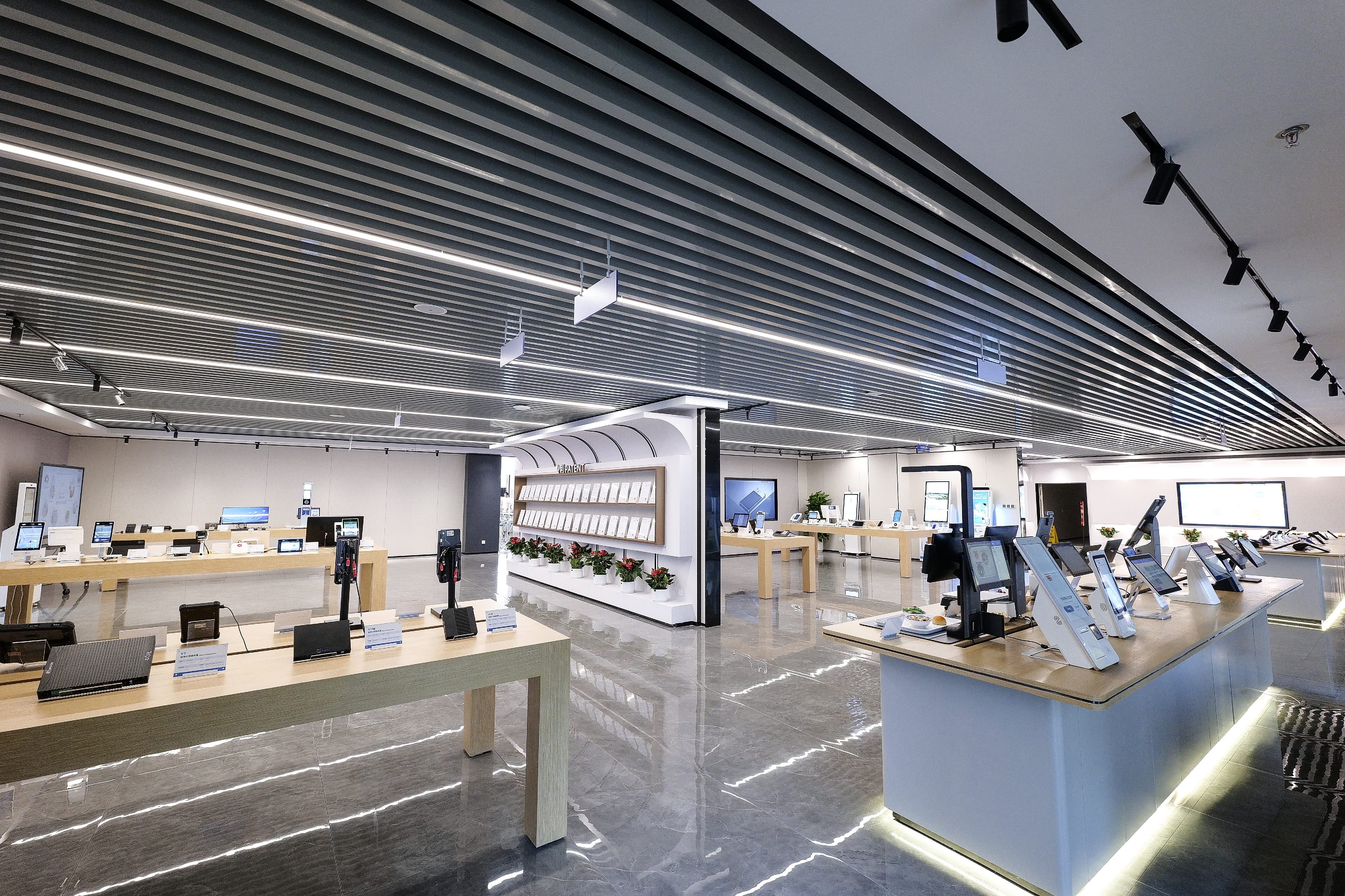
Next step: Review configuration options for self-service kiosks, Android POS terminals, and handheld terminals in the Telpo product brochure, or send your lane plan and certification requirements to business@telpo.com (Tel: +86 757 86337898-324; WhatsApp: +86 18603080594) for a configuration and sample discussion.
Have Questions or Need More Details?
Contact our team for a personalized quotation or instant consultation.
Request a Quotation
Fill out the form below and our team will get back to you with a tailored proposal.
WhatsApp Direct Chat
Prefer to chat in real-time? Message us on WhatsApp for instant assistance & quick answers.
- Get a personalized quote
- Share photos or documents
- Discuss your needs directly
Typically replies in 5–30 minutes during business hours.