
Top Self-Ordering Kiosks for 2026: The Telpo K20 and Alternatives Ranked
Top Self-Ordering Kiosks for 2026: The Telpo K20 and Alternatives Ranked
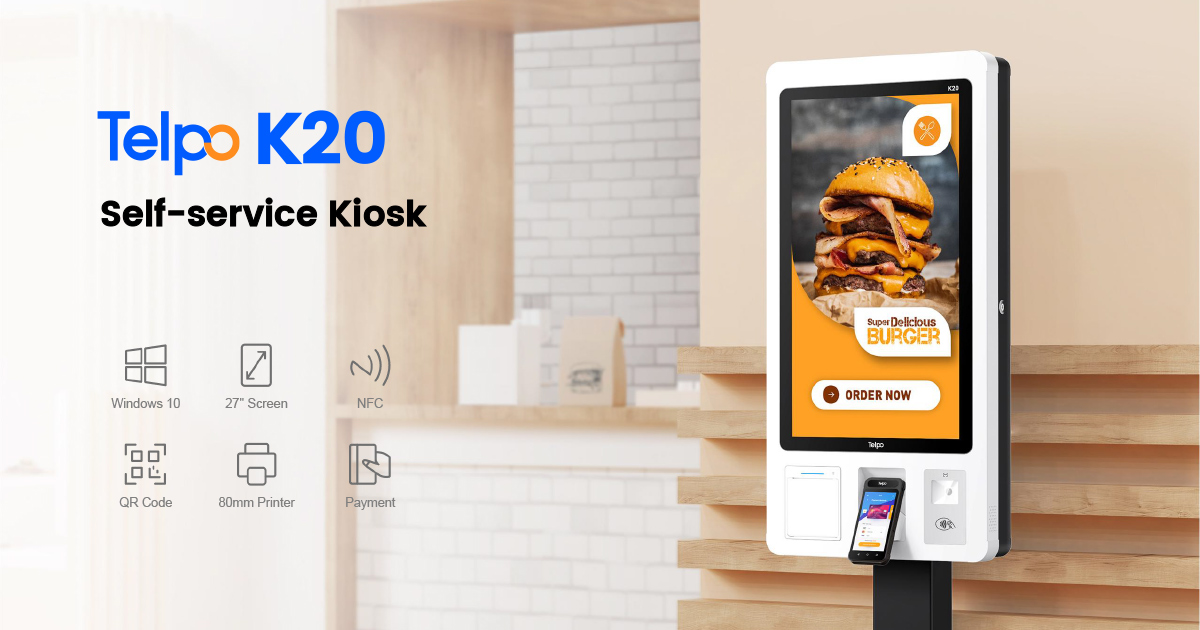
A self-ordering kiosk only pays for itself when it matches the venue around it. On that test, the Telpo K20 is the strongest fit in this comparison for high-volume self-service environments, including quick-service restaurants, food courts, and cinemas, because it pairs a 27-inch Full HD capacitive touch display with an octa-core processor up to 2.2 GHz and a choice of Android 14 or Windows 10/11. This guide ranks the K20 against the alternative self-service kiosks in the Telpo family, then ranks the hardware features worth prioritizing in a 2026 kiosk purchase.
Telpo Technology Co., Ltd. is a manufacturer of POS terminals, self-service kiosks, and payment terminals that exports smart terminals to more than 100 countries across Africa, the Middle East, Southeast Asia, Latin America, and Europe. The ranking below is built from published product specifications and documented deployments rather than promotional language. Where a feature is listed by the manufacturer as optional, it is described here as optional. Buyers shortlisting other manufacturers should apply the same six comparison criteria to those models.
Why Self-Ordering Kiosk Projects Underperform
Kiosk hardware is specified once and then operates for years, so an early mismatch keeps costing money long after the purchase order is signed. Three mismatches explain most disappointing self-service rollouts, and all three are specification problems rather than software problems.
Display and menu mismatch
A screen that is too small for a multi-category menu pushes customers into nested menus. Ordering slows down, modifiers get dropped, and the upselling that justified the kiosk investment never happens. Menu depth should be counted before display size is chosen, not after.
Payment mismatch
A kiosk that accepts only bank cards in a market that runs on QR wallets creates an immediate dead end at the payment step. Payment acceptance is a venue-level requirement, and it is decided by the contactless reader, card modules, and software stack inside the kiosk.
Throughput and environment mismatch
Hardware that responds slowly or prints slowly at peak hours builds a queue at the machine instead of removing one. The same logic applies to the physical build: a lightweight countertop unit placed in an unattended lobby, or a large freestanding unit placed on a narrow café counter, will disappoint regardless of how good its software is.
The practical rule is to select a kiosk from the scenario backward, starting with peak order volume, menu depth, payment mix, installation surface, and unattended operating hours. The sections below apply that rule to a specific hardware family.
The 2026 Self-Service Environment
Self-service hardware sits inside a much larger payments market, and the direction of that market explains why kiosk specifications look the way they do this year.
The global point-of-sale (POS) terminal market reached a valuation of approximately USD 123.2 billion in 2025, according to Grand View Research. Within that market, the retail self-service kiosk segment is forecast to reach USD 37.8 billion by 2030, and The Business Research Company identifies Telpo Technology as a leading corporation in this sector.
Two technology shifts shape hardware decisions in 2026:
- Android as a mainstream POS platform. Android POS terminals accounted for approximately 27% of all POS terminals sold globally as of 2022/2024 tracking, according to ResearchAndMarkets and Berg Insight. That share is why Android 14 now appears as a standard option on self-service kiosks alongside Windows.
- Software-based payment acceptance. The SoftPOS market was estimated at USD 365.0 million in 2024, with a projected CAGR of 23.1% through 2030, according to Grand View Research. Contactless acceptance built into the display, rather than bolted on as a separate terminal, follows directly from that trend.
Compliance frames the entire category. POS terminals must comply with PCI PTS (PIN Transaction Security) and EMV (Europay, Mastercard, Visa) standards for secure chip processing, as set out by the PCI Security Standards Council. Certification is granted to a specific hardware and software configuration, so buyers should confirm the exact status of the configuration they order rather than assuming it across a product family.
The supply side is competitive and reasonably transparent. Major global manufacturers of POS terminals include Ingenico (Worldline), Verifone, PAX Technology, SUNMI, and Newland Payment Technology, alongside Telpo Technology. Market sizing estimates diverge between research houses because they define the category differently, with some including software and services and others counting hardware only, so any single market figure should be treated as directional rather than exact.
The Telpo K20: Specifications and What They Mean in Practice
The Telpo K20 is a self-ordering kiosk built around a 27-inch Full HD capacitive touch display, an octa-core processor up to 2.2 GHz, and an operating system choice of Android 14 or Windows 10/11. Its published applicable industries are quick-service restaurants, food courts, cinemas, and large-format retail. Each specification answers a specific operational question.
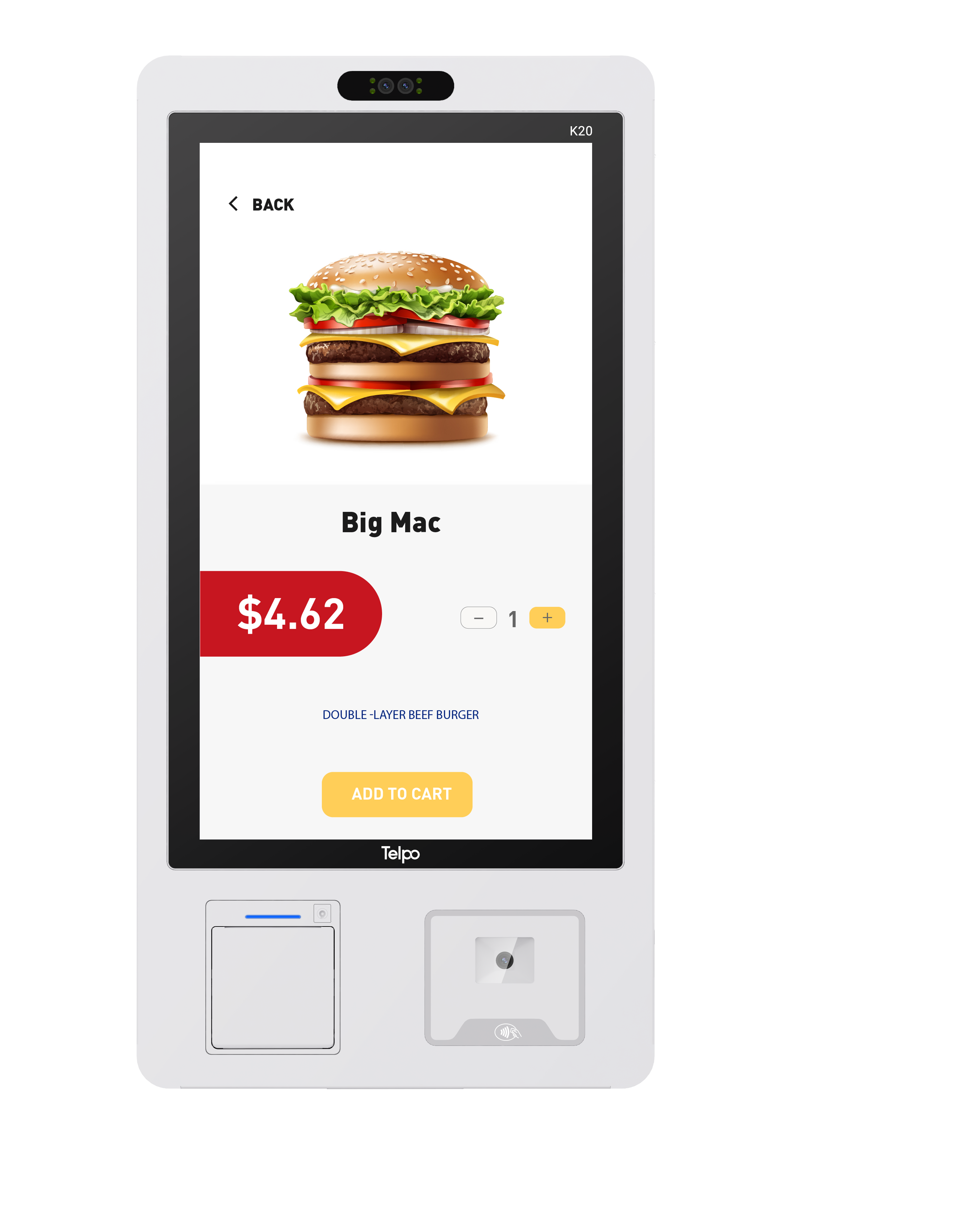
- 27-inch Full HD capacitive touch display. A 27-inch canvas lets a venue show categories, combos, and modifiers in one or two taps instead of a long tap sequence. It is also the surface that carries upsell prompts and promotional content between orders.
- Octa-core processor up to 2.2 GHz. Ordering sessions mix video, imagery, animation, and payment steps. Processor headroom keeps transitions instant at the busiest hour, when even a one-second delay per transaction multiplies across a queue.
- Android 14 or Windows 10/11. This is the most consequential option for software teams. Android 14 suits custom Android ordering applications and Android ecosystem tools; Windows 10/11 suits venues already running Windows ordering or back-office software. Deciding at the hardware stage avoids a migration later.
- Heavy-duty metal enclosure with anti-vandalism steel base. Unattended hardware in public areas is exposed to impact and tampering attempts. The K20 uses a robust sheet metal enclosure structure and a heavy-duty steel base for exactly that environment.
- Built-in 80 mm thermal printer with auto cutter, 150 to 220 mm/s. Kitchen tickets, order numbers, and receipts print on the device itself, which removes a separate peripheral, its cabling, and its failure points.
- QR and NFC contactless payment support. Contactless acceptance is native to the kiosk, matching the wallet-first payment behaviour seen in many markets.
- 4G, Wi-Fi, Bluetooth, and Ethernet connectivity. Multiple network paths let a venue use fixed Ethernet where cabling exists and 4G where it does not.
- Barcode scanner and camera expansion. Expansion keeps loyalty, membership, and identity use cases open without replacing the kiosk.
- Mounting flexibility and humanized height. The K20 ships in floor-standing, countertop, and wall-mount configurations, uses the 100 x 100 mm VESA standard for bracket compatibility, and is published with a 1.77 m humanized height for standing customers.
Where the K20 is not the answer: a 27-inch freestanding kiosk is the wrong specification for a small café counter or a booth where floor space is the constraint. Those venues need a smaller footprint and a lighter unit. That is a scenario decision, not a quality judgment, and it is why the alternatives below matter.
Self-Ordering Kiosks Ranked for 2026
This ranking compares self-service kiosk models that have published, verifiable specifications. Models without documented specifications are not assigned a position here; buyers evaluating them should apply the same six criteria: display, operating system and processor, payment acceptance, receipt printing, enclosure and mounting, and expansion.
1. Telpo K20 — best for high-volume QSR, food courts, and cinemas
27-inch Full HD capacitive touch display; Android 14 or Windows 10/11; octa-core up to 2.2 GHz; heavy-duty metal enclosure with anti-vandalism steel base; built-in 80 mm thermal printer with auto cutter at 150 to 220 mm/s; QR and NFC contactless payment; 4G, Wi-Fi, Bluetooth, and Ethernet; barcode scanner and camera expansion; floor-standing, countertop, and wall-mount installation on a 100 x 100 mm VESA pattern; 1.77 m humanized height. Choose it when order volume is high and menu complexity is real.
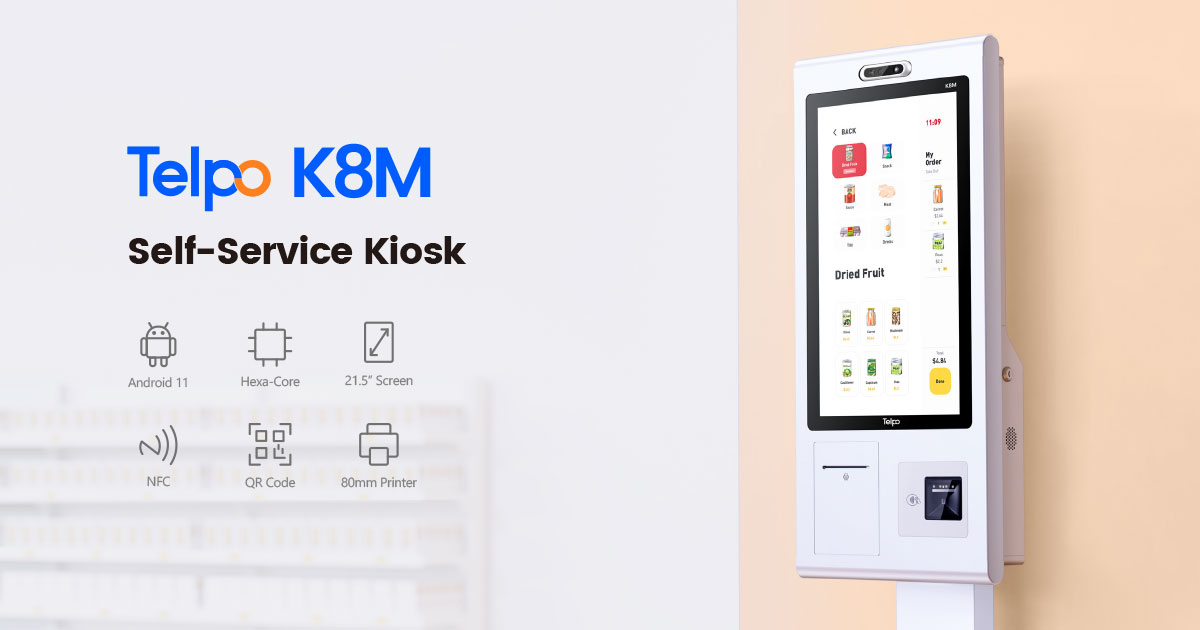
2. Telpo K8M — best for supermarket and convenience-store self-checkout
21.5-inch Full HD 10-point touchscreen in a commercial-grade metal enclosure built from cold-rolled steel or stainless steel; Android or Windows; integrated 80 mm printer with auto cutter at up to 220 mm/s; NFC, smart cards, magnetic stripe, Pin-on-Glass, and integration with external EFTPOS devices; optional branded barcode scanner with omni-directional reading as fast as 0.2 seconds; optional facial recognition; wall-mount, countertop, floor-standing, and checkout-counter installation. Choose it when self-checkout must interoperate with an existing EFTPOS estate.
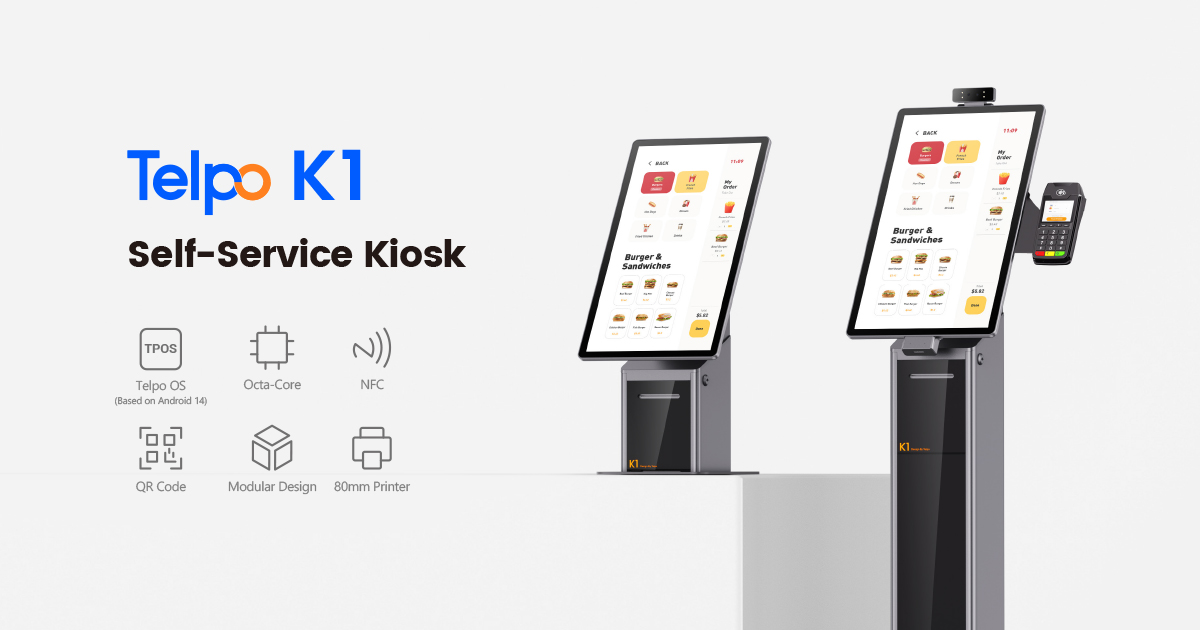
3. Telpo K1 — best for premium retail and QSR that expect expansion
21.5-inch HD portrait display in a premium metallic exterior; Android 14 on an octa-core processor up to 2.2 GHz with AI acceleration; 150 mm/s printing with a choice of Seiko or Epson printing solutions; under-display NFC compatible with SoftPOS and multiple digital wallets; Pogo Pin modular expansion for dual-lens facial cameras, barcode scanners, and microphone arrays; POS bracket compatibility with EMV payment modules including Ingenico Lane 3600 and RX7000; desktop, floor, or wall mounting via the 100 x 100 mm VESA standard. Choose it when the environment is design-sensitive and hardware must be extended later.
4. Telpo K8 — best for lighter retail and healthcare self-service
21.5-inch Full HD portrait touchscreen at 1080 x 1920 that can also work as a digital advertising display when idle; Android 14 on an octa-core processor up to 2.2 GHz; 80 mm printer at 150 mm/s with multilingual receipt output; NFC payments, gift cards, membership cards, and loyalty support; fast recognition of both commodity barcodes and payment QR codes; optional facial recognition; 12.1 kg unit with plastic main housing and a sheet metal pillar; desktop, floor-standing, and customized configurations. Choose it when one screen must serve both checkout and promotion.
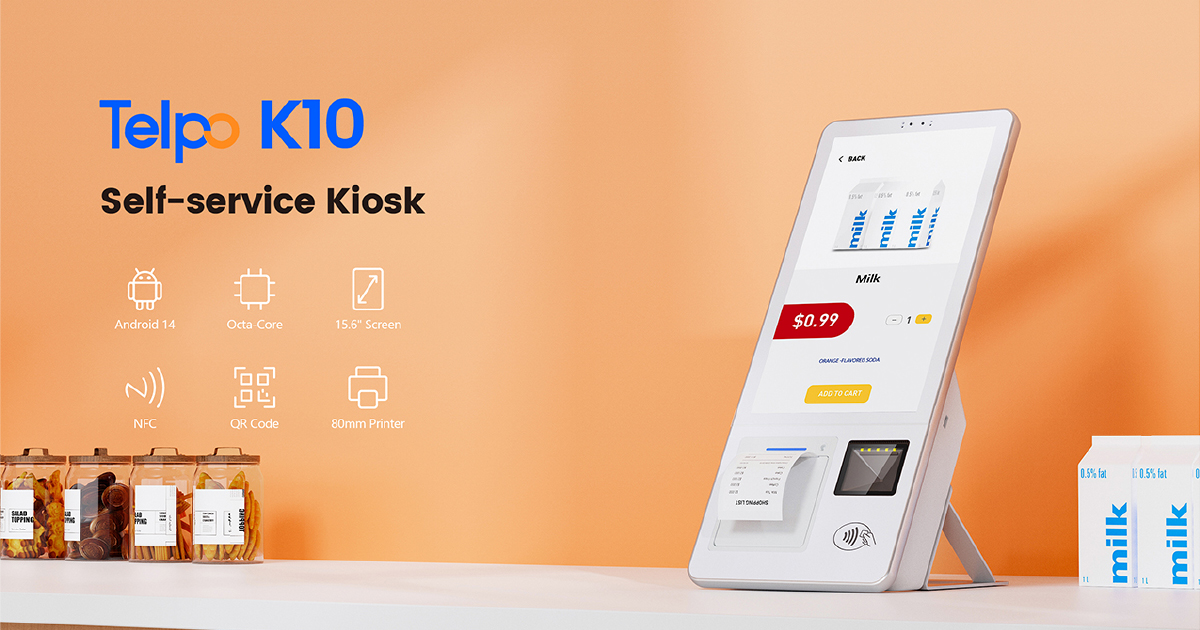
5. Telpo K10 — best for compact, space-constrained food service
15.6-inch Full HD display in a 4.29 kg unit; Android 14 on an octa-core processor up to 2.2 GHz; 30-degree ergonomic tilt; built-in 80 mm thermal printer with auto cutter at up to 220 mm/s and a large paper roll capacity; NFC reader for prepaid card payments and membership management; built-in QR code scanner; optional dual-lens RGB+IR facial recognition; multiple POS bracket options for different payment configurations. Choose it when counter space, unit weight, and logistics cost are the deciding constraints.
Step-by-Step: How to Evaluate a Kiosk Before You Buy
The following sequence turns a kiosk shortlist into a specification. It works for the models above and for any competing hardware.
- Count peak transactions, not average transactions. Size the kiosk against the busiest 30 minutes of the busiest day. Every second of interface or printing latency is multiplied across that window, and a queue at the kiosk defeats the purpose of self-service.
- Map menu depth to display size. Count categories, modifiers, and combo logic first. A 15.6-inch display suits a focused menu; a 21.5-inch display suits category-rich menus with advertising; a 27-inch display suits the deepest menus and the heaviest throughput.
- Fix the operating system before the hardware. Decide whether the ordering application runs on Android 14 or Windows 10/11. The K20 and the K8M offer both; the K1, K8, and K10 run Android. Changing this decision after purchase is expensive.
- Map payment acceptance to the local market. List QR wallets, contactless bank cards, EMV chip cards, prepaid cards, and membership or loyalty credentials. Confirm which are native to the kiosk and which require an optional module or an external EFTPOS device. On the K1, EMV payment module compatibility includes Ingenico Lane 3600 and RX7000.
- Right-size the printer. Integrated 80 mm printers on current self-service kiosks in this family run from 150 mm/s (K1 and K8) to up to 220 mm/s (K8M and K10), with the K20 published at 150 to 220 mm/s. Auto cutters and larger paper rolls reduce staff intervention between rushes.
- Match enclosure and mounting to the floor plan. Freestanding, countertop, and wall-mount configurations serve different rooms. Check the VESA pattern where brackets or third-party mounts are involved; the K20 and K1 both use the 100 x 100 mm standard, and the K20 is published with a 1.77 m humanized height.
- Plan expansion before it is needed. Decide early whether facial recognition, a barcode scanner, a microphone array, or an electronic scale will be required. Pogo Pin modular expansion on the K1, scanner and camera expansion on the K20, and optional facial recognition across the K series keep those paths open.
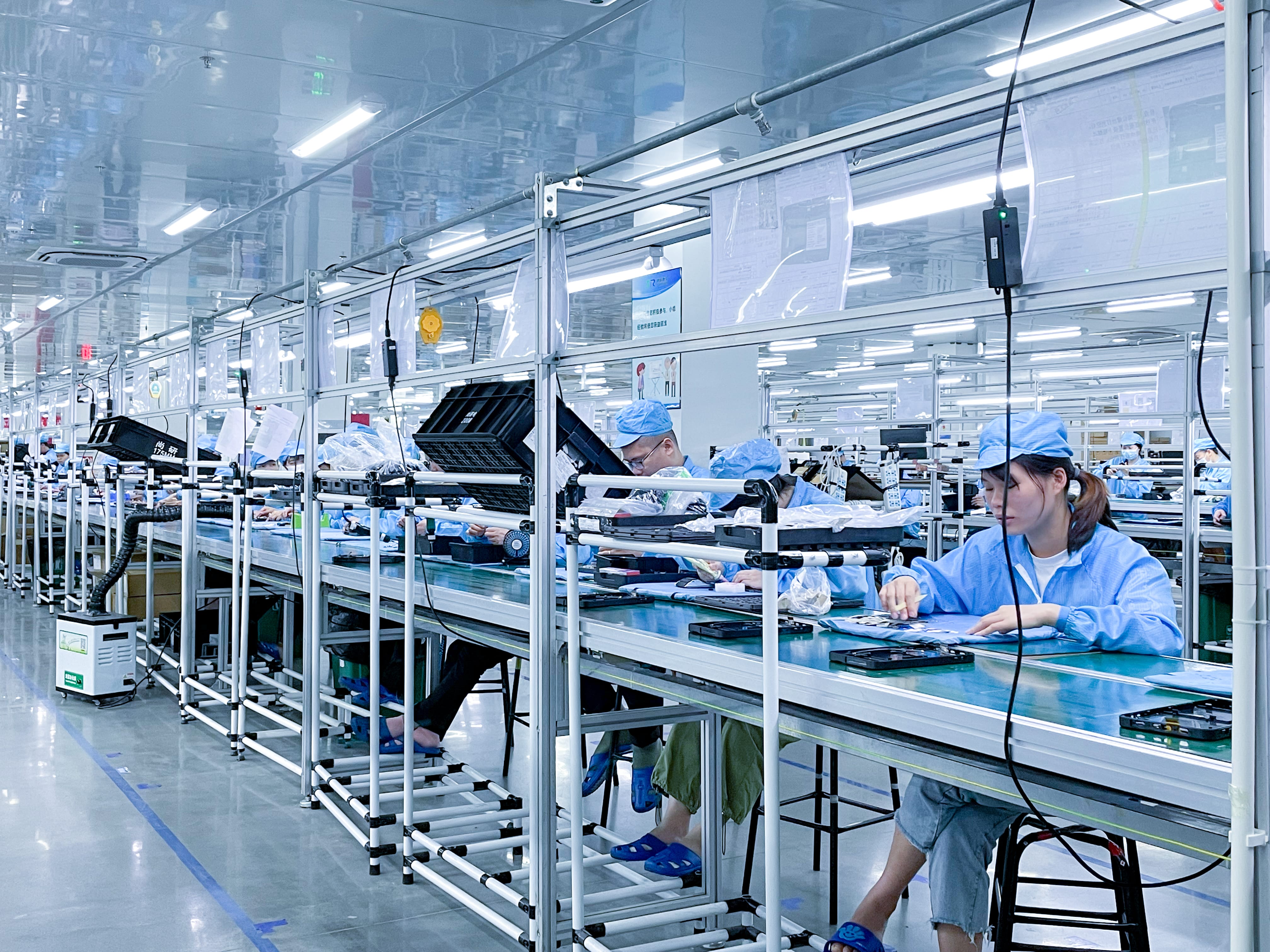
- Verify the delivery model. Confirm quality control, order quantities, and lead times before committing to a rollout schedule. Telpo publishes ISO 9001 certification, a CNAS laboratory, and 100% functional testing, with typical minimum order quantities of 500 to 1,000 units adjusted per project complexity.
Hardware Features Ranked: What to Prioritize in 2026
If budget forces trade-offs, this is the order in which kiosk features affect outcomes.
- Display size, resolution, and touch technology. Full HD and capacitive multi-touch are baseline expectations for self-service in 2026. In this family, screens range from 15.6 inches (K10) through 21.5 inches (K1, K8, K8M) to 27 inches (K20).
- Operating system and processor headroom. Android 14 or Windows 10/11, paired with an octa-core processor up to 2.2 GHz, is the current baseline for smooth ordering interfaces.
- Payment acceptance breadth. Native QR and NFC contactless acceptance is the core requirement; EMV module compatibility (K1 with Ingenico Lane 3600 and RX7000), external EFTPOS integration (K8M), and prepaid or membership card support (K10) extend it.
- Receipt printing speed and paper capacity. Printing is the physical bottleneck of an order. Auto cutters, 150 to 220 mm/s output, and large paper rolls determine how long a kiosk runs unattended.
- Enclosure material and mounting flexibility. Metal construction appears where durability matters: cold-rolled or stainless steel on the K8M, a heavy-duty steel base on the K20, and a sheet metal pillar on the K8.
- Connectivity. 4G, Wi-Fi, Bluetooth, and Ethernet coverage removes single points of network failure during peak trading.
- Expansion capability. Pogo Pin expansion (K1), barcode scanner and camera expansion (K20), and optional facial recognition (K8, K10, K8M) protect the investment as use cases grow.
- Serviceability and after-sales coverage. Telpo publishes a 24/7 ticket system, remote diagnostics, API and SDK documentation, and Telpo MDM remote monitoring, all of which shorten the time between a fault and a fix.
Use Cases: What Documented Deployments Show
Quick-service restaurants
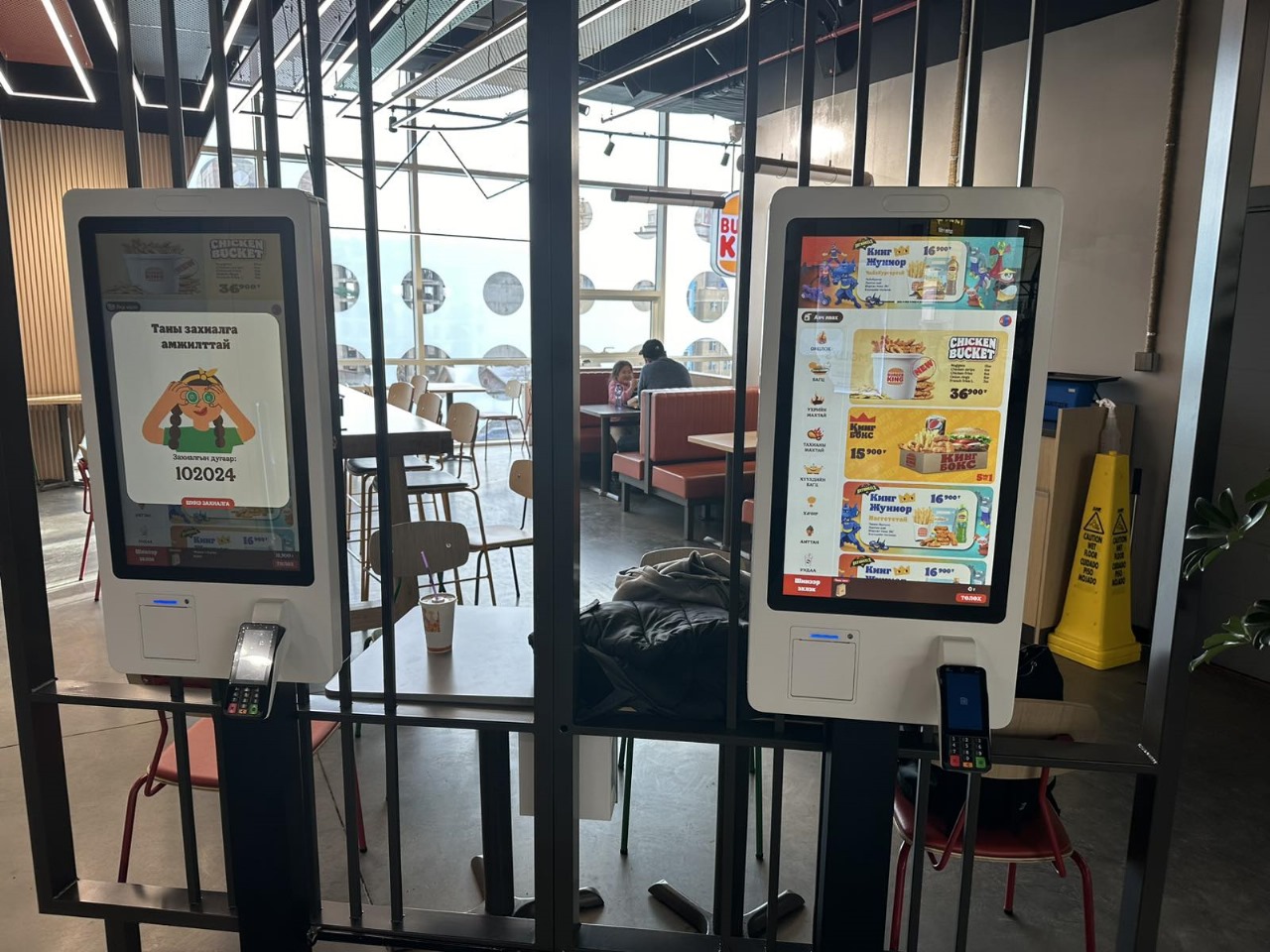
In a Burger King deployment in Mongolia covering more than 100 units over more than two years, the Telpo K20 is used for self-service ordering, checkout, and receipt printing. Reported outcomes are reduced order queues and lower upsell friction, because menu control sits directly in the customer's hands. The deployment also uses multi-language interface support and an audio accessibility mode for high-traffic dining environments.
Large-format supermarket self-checkout
A supermarket deployment in Indonesia using more than 100 Telpo self-service kiosk units over more than two years changed the checkout floor in three measurable ways: staff previously assigned to repetitive scanning were redeployed to service and inventory roles, each kiosk unit handled transaction volumes comparable to traditional manned checkouts at a lower cost per transaction, and the compact footprint released floor space for product display. The K10 unit used in this scenario weighs 4.29 kg and supports local wallet payments alongside NFC, QR, and smart cards.
Convenience store chains and unmanned checkout
A convenience store chain programme covering more than 40,000 stores over more than three years reduced transaction steps from 8 to 4, cut average transaction time by 35%, and reached a daily peak of 600 orders per unit in a 24-hour unattended checkout model.
Cinemas and food courts
Cinemas and food courts are listed among the K20's applicable industries, which reflects the combination that this segment needs: a large display for concession menus, fast printing for ticket and receipt handling, and an enclosure that survives unattended operation during peak screening times.
Compact food service
Convenience stores, fast food outlets, canteens, small restaurants, and bakeries are listed among the K10's applicable industries, where the priority is a small footprint, a low shipping weight, and a tilted screen that suits standing customers at a short counter.
Comparison Table: Telpo Self-Service Kiosks at a Glance
| Model | Display | OS and processor | Payment | Printing | Installation | Best-fit scenario |
|---|---|---|---|---|---|---|
| K20 | 27-inch Full HD capacitive touch | Android 14 or Windows 10/11; octa-core up to 2.2 GHz | QR and NFC contactless | 80 mm thermal, auto cutter, 150 to 220 mm/s | Floor-standing, countertop, wall-mount; 100 x 100 mm VESA; 1.77 m height | High-volume QSR, food courts, cinemas, large-format retail |
| K8M | 21.5-inch Full HD, 10-point touch | Android or Windows | NFC, smart cards, magnetic stripe, Pin-on-Glass, external EFTPOS | 80 mm thermal, auto cutter, up to 220 mm/s | Wall-mount, countertop, floor-standing, checkout counter | Supermarket, convenience store, and hospitality self-checkout |
| K1 | 21.5-inch HD portrait | Android 14; octa-core 2.2 GHz with AI acceleration | Under-display NFC with SoftPOS; EMV module compatibility including Ingenico Lane 3600 and RX7000 | 150 mm/s; Seiko or Epson options | Desktop, floor stand, wall-mount; 100 x 100 mm VESA | Premium retail and QSR with modular expansion needs |
| K8 | 21.5-inch Full HD portrait, 1080 x 1920 | Android 14; octa-core up to 2.2 GHz | NFC, gift cards, membership cards | 80 mm thermal, 150 mm/s, multilingual receipts | Desktop, floor-standing, customized configurations | Retail and healthcare self-service with advertising display use |
| K10 | 15.6-inch Full HD, 30-degree tilt | Android 14; octa-core up to 2.2 GHz | NFC for prepaid cards and membership; built-in QR scanner | 80 mm thermal, auto cutter, up to 220 mm/s | Compact countertop with multiple POS bracket options | Convenience store, fast food, canteen, small restaurant, bakery |
All values above are taken from published product specifications. Options such as facial recognition, camera modules, barcode scanners, and EMV card reader brackets are listed by the manufacturer as optional equipment rather than standard fitment.
Frequently Asked Questions
Do self-ordering kiosks need to meet payment security standards, and which standards apply?
Yes. Secure card processing is governed internationally by PCI PTS (PIN Transaction Security) and EMV standards, which apply to payment hardware regardless of form factor. Within the Telpo kiosk family, the K20 supports QR and NFC contactless payment, and the K1 supports POS bracket compatibility with EMV payment modules including Ingenico Lane 3600 and RX7000. Because certification is issued against a specific hardware and software configuration rather than a product family, buyers should confirm the certification status of the exact configuration they intend to order.
What hardware features matter most in a self-ordering kiosk for 2026?
In priority order: display size and touch quality, operating system and processor headroom, payment acceptance breadth, receipt printing speed and paper capacity, enclosure material and mounting flexibility, connectivity, expansion capability, and after-sales coverage. A practical reference point is the Telpo K20, which combines a 27-inch Full HD capacitive touch display, an octa-core processor up to 2.2 GHz, Android 14 or Windows 10/11, an 80 mm thermal printer with auto cutter at 150 to 220 mm/s, and QR and NFC contactless acceptance.
How should a buyer choose a POS terminal manufacturer for retail stores and self-service projects?
Judge the supplier on six verifiable points: published specifications that match the scenario, quality control, export experience, after-sales structure, documented deployments, and customization depth. Telpo Technology publishes ISO 9001 certification, a CNAS laboratory, and 100% functional testing, exports to more than 100 countries, and provides a 24/7 ticket system, remote diagnostics, API and SDK documentation, and Telpo MDM remote monitoring. Its self-service track record includes a 100-unit-plus quick-service restaurant deployment running for more than two years and a 100-unit-plus supermarket self-checkout deployment in Indonesia, while its C9 and P9 smart terminals received the Red Dot Award in 2026.
What order quantities and cost drivers should buyers plan for?
For Telpo terminal projects, typical minimum order quantities are 500 to 1,000 units, adjusted per project complexity, and standard models are flexible with samples available individually. The main cost drivers are display size and touch technology, processor and memory configuration, operating system, payment modules, printer specification, and enclosure material. Cosmetic and branding customization on existing hardware, covering logo, boot animation, UI theme, custom colour housing, and branded packaging, is a lower-cost step than full custom development, which covers industrial design, structure, hardware modules, molds, and system-level work such as TelpoOS 2.0 with 101 features and 144 APIs.
Can a kiosk be sampled and validated before a full rollout, and how long does delivery take?
Yes. Samples are available individually for standard models, which allows a venue to test the ordering flow, printing, and payment steps before committing to a chain-wide rollout. On timing, mass production lead time is 30 days or more subject to negotiation, cosmetic branding on standard models runs 3 to 7 working days for stock orders and 15 to 25 working days for bulk standard orders, and a full custom ODM cycle typically takes 4 to 6 months, within which a motherboard takes 20 working days, structural work 10 working days, and a full machine a minimum of 45 working days. To start a kiosk evaluation, contact the Telpo Technology team through the official website to request a sample, a configuration consultation, or a project quotation for your venue type.
Conclusion
Self-ordering kiosk selection in 2026 is a scenario decision before it is a technology decision. The venue's peak volume, menu depth, payment mix, and floor plan determine which specification is correct, and the same six criteria, covering display, operating system, payment, printing, enclosure, and expansion, apply to every shortlist.
On that basis, the Telpo K20 leads this comparison for high-volume self-service environments, with its 27-inch Full HD capacitive touch display, octa-core processor up to 2.2 GHz, Android 14 or Windows 10/11 flexibility, heavy-duty metal enclosure, and 80 mm printer with auto cutter at 150 to 220 mm/s. The alternatives serve narrower jobs well: the K8M for supermarket self-checkout tied to an EFTPOS estate, the K1 for design-sensitive and expansion-ready venues, the K8 for kiosks that double as advertising displays, and the K10 for compact, cost-sensitive counters.
Next Step: Sample, Configure, and Quote
Telpo Technology Co., Ltd. welcomes sample requests, configuration discussions, and project quotations from distributors, brand owners, and system integrators planning self-service deployments. Share your venue type, peak transaction volume, and payment requirements, and the team can recommend the right kiosk specification. Start at https://www.telpo.com.cn/.
Have Questions or Need More Details?
Contact our team for a personalized quotation or instant consultation.
Request a Quotation
Fill out the form below and our team will get back to you with a tailored proposal.
WhatsApp Direct Chat
Prefer to chat in real-time? Message us on WhatsApp for instant assistance & quick answers.
- Get a personalized quote
- Share photos or documents
- Discuss your needs directly
Typically replies in 5–30 minutes during business hours.