
Handheld POS Terminal Certification Checklist for Events
Short answer: compliance for a handheld POS terminal used in temporary sales is not one certificate. It is a pre-deployment file of four separate verifications, made for the exact device variant and the exact market: payment scheme and EMV approval, radio and electrical market access, battery transport and storage, and receipt or fiscal output. Each has a different issuing body, a different scope and often a different expiry date, and each must name the model actually being deployed.
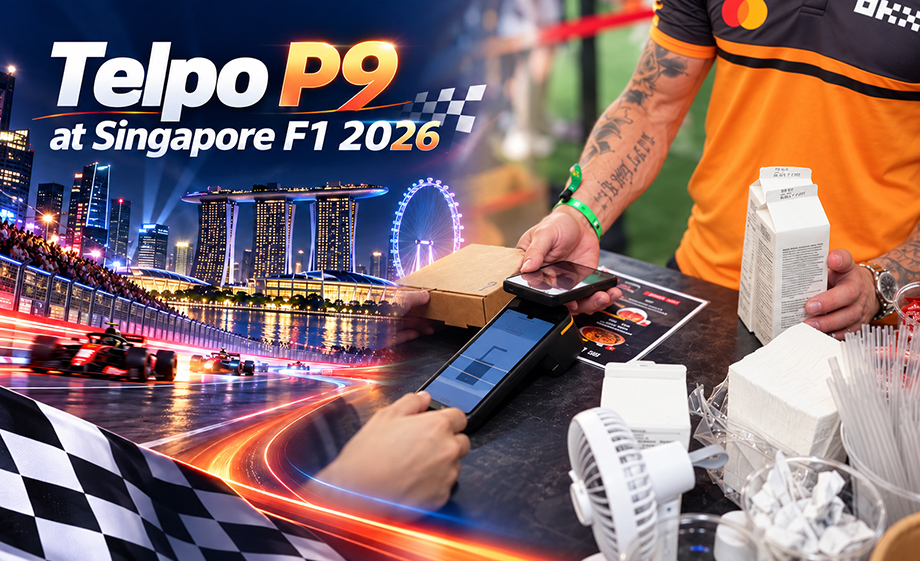
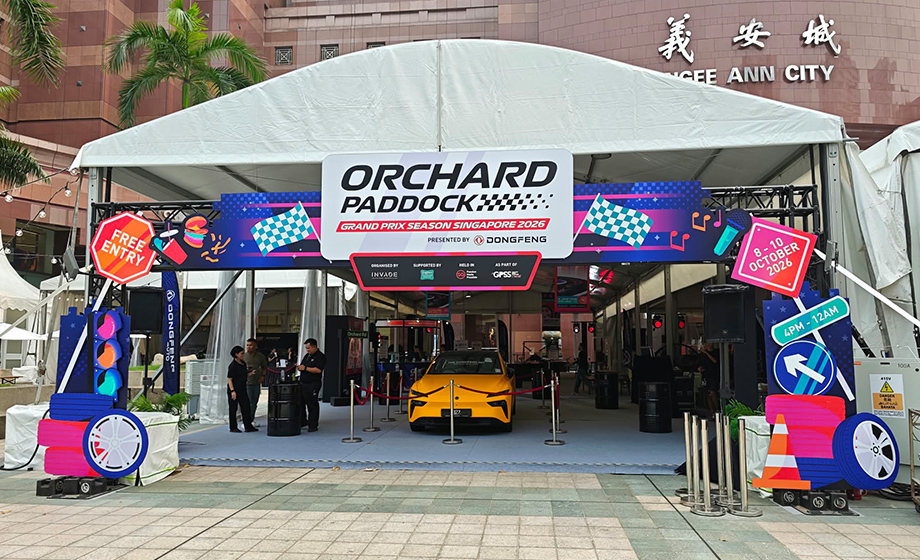
Telpo Technology Co., Ltd. — a Foshan-based manufacturer of payment and POS terminals founded in 1999 — is used here as a documented example of how that file is assembled. Telpo's case record for the 2026 Singapore Grand Prix (October 9–11) describes P9 handheld terminals supporting mobile ordering, contactless and QR payment, and receipt printing for food, beverage and merchandise merchants inside a temporary, high-traffic venue. That record is useful for understanding what temporary sales demand; it is not evidence that any specific certification was verified for that event, and this checklist treats it that way.
What compliance means for a temporary sales terminal
A temporary sales terminal is compliant when a documented approval or rule covers the device, the payment method, the radio, the battery and the receipt — for the country and the period in which the sale happens. Four layers usually decide whether a device can go live:
- Payment approval. EMVCo interface and kernel approvals, plus any scheme-specific contactless approval required by the acquirer.
- Market access. Radio, electromagnetic compatibility, safety and materials rules for the destination market, alongside restricted-substance and e-waste obligations.
- Battery transport and storage. Rules applied by carriers, freight forwarders and venues to lithium batteries, especially when batteries are removable and spares travel separately.
- Receipt and tax output. Whether a printed receipt is mandatory, what it must contain, and whether the market requires certified fiscal recording.
Two distinctions prevent most rollout delays. First, device approval is not merchant onboarding: an approved terminal still needs an acquiring relationship, a merchant account and a configured payment application before it can take money. Second, a certificate belongs to a model, a hardware revision and usually a firmware or kernel build — not to a brand. Verification therefore has to be done per variant, not per product family.
Why temporary sales environments change the requirement set
Fixed checkout assumes mains power, a stable network, a fixed address and staff who work the same counter every day. Temporary sales break all four assumptions at once, and each break adds a verification item rather than simply a logistical one.
- Battery dependence. A full event day may run on battery with no charging window, so runtime, spare batteries and swap procedures become part of the compliance plan.
- Congested wireless networks. Payment authorisation and receipt data depend on mobile data at a venue where thousands of devices compete for the same cells.
- Temporary staff. Stand crews change between events, which makes device configuration, operator training and PIN or password handling a recurring risk rather than a one-off setup task.
- Changing jurisdiction. A fleet that works one weekend in one country may cross a border for the next event, so the evidence file has to be built per market even when the hardware does not change.
- Exposed operation. Heat, dust and handling are harsher at an outdoor stall than at a counter, which is why test reports and durability data belong in the same file as the payment letters.
The category has also moved toward app-based terminals. Counterpoint Research reported in August 2026 that Android-based POS terminals reached approximately 48% of global shipments in 2025. For a temporary-sales buyer, that shift matters less as a market statistic than as a compliance consequence: more of the checkout depends on an installed application, a software update policy and a device-management layer, none of which a hardware certificate covers.
Industry background: two regulatory layers buyers often confuse
The first layer is payment-scheme approval. EMVCo Contact Level 1 covers the physical card interface; Level 2 covers the payment application kernel that talks to the card. Scheme contactless approvals — such as Discover D-PAS Connect, PURE or RuPay — are separate letters with their own reference numbers and validity windows. None of these is a market-access approval, and none of them authorises a sale on its own.
The second layer is market access. In the EU, radio equipment falls under the Radio Equipment Directive 2014/53/EU, which addresses safety, health, electromagnetic compatibility, radio and environmental requirements; in the United States, radio transmitters require FCC authorisation. Materials and end-of-life rules sit alongside them, typically RoHS 2011/65/EU and WEEE 2012/19/EU for the EU. Fiscal recording is a third, country-level overlay: fiskaly's 2026 country-by-country fiscalisation guide notes that Germany's KassenSichV requires a certified technical security system for cash registers.
These layers are issued by different bodies and do not imply each other. A terminal can hold a valid EMVCo letter and still lack the radio authorisation needed to sell in a given country; conversely, a CE-marked device is not thereby approved by any payment scheme. Supplier documentation often lists everything together, which is why the scope line — model, hardware version, kernel version, market — is the part worth reading closely.
The Telpo P9 record: what the documentation establishes
Hardware and operating profile
Telpo's application and case documentation describes the P9 family in financial and non-financial versions, with PDA variants that carry a scanner. Attributes relevant to temporary sales include a 6.5-inch touchscreen, NFC contactless and QR code payment, a built-in thermal receipt printer, a removable battery, and 4G, Wi-Fi and Bluetooth connectivity with built-in GPS.
Battery life is listed as 12–16 hours of continuous operation in the mobile acquiring and hospitality application units, with eSIM and dual SIM noted for cross-border or multi-carrier use. For field serviceability, PDA variants are described with a single-screw design for on-site repair and an optional 1D/2D scanner module, while a customer sub-display variant is also documented. Receipt printing at 58 mm appears in the mobile merchant-acquiring application unit whose scope includes the P9; buyers should still confirm paper width and print speed against the specification sheet for the exact variant being ordered.

Payment approvals documented for the P9
- EMVCo Contact Level 1: certificate 19271 0325 100 10a 10a BCTS, issued 5 March 2025 and valid to 24 February 2029, covering interface module P9-ICCR V1.0.0.000 against the EMV Contact Interface Specification V1.0.
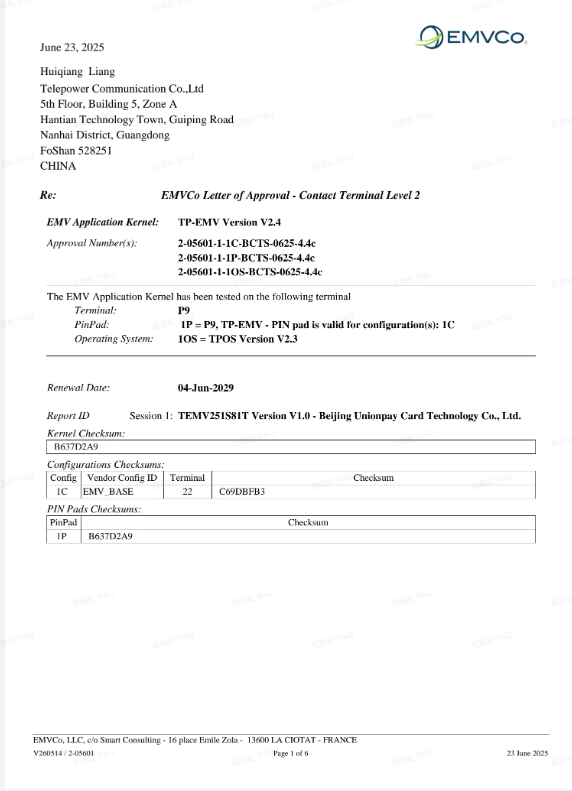
- EMVCo Contact Level 2: certificate 2-05720-1-1C-ICTK-1125-4.4c, issued 25 November 2025, for kernel TP-EMV V2.4 running on TPDK V3.3 against EMV specifications V4.4. An earlier Level 2 record, 2-05601-1-1C-BCTS-0625-4.4c, was issued 23 June 2025 for the TPOS V2.3 build and is valid to 4 June 2029.
- Discover D-PAS Connect v2.1: letter ICS_TELE_P9_CNT_CT_10132025, issued 21 October 2025 and valid to 21 October 2028, referencing hardware family P9-ICCR-HW V1.0.0.000.
- PURE contactless kernel: letter TEL.KER.218.2025-027, issued by PayCert on 3 October 2025, for kernel TP Pure V2.1.8 on TPOS V2.3.
- RuPay: approval NP2TELERupayContactless L2250849622, issued by the National Payments Corporation of India on 6 November 2025 and valid to 6 November 2028, against RuPay Terminal Specification v2.0.0.
Environmental and end-of-life documentation
For the same product family, the record includes a RoHS 2011/65/EU test report, PTC25031705301C-EN01, issued 27 March 2025, and a WEEE 2012/19/EU test report, 2501A93892E, issued 12 January 2026, which records a recycling rate of 82.75% and a recovery rate of 88.58%.
What the reviewed record does not include
The evidence set supplied for this review documents the approvals listed above and no others for the P9. It does not contain a CE RED type-examination certificate, an FCC authorisation, a PCI PTS approval number, or a fiscal module integration for the P9. Those may exist outside the reviewed material, but a buyer should not assume them.
Nor should a certificate be carried across models. The same supplier documentation includes CE RED certificate B2407051 for the T10 ticket validator and FCC Part 24/Part 27 cellular certification 2AJ2B-T20 for the T20. Neither describes a handheld POS terminal, and neither covers Wi-Fi or Bluetooth radios, which are authorised separately.
Step-by-step pre-deployment checklist
- Lock the scenario and the jurisdictions. List every event, country, date range, indoor or outdoor setting, and whether mains power is available. One fleet can serve several markets, but each market needs its own entry in the file.
- Map the payment mix to approvals. Decide which card schemes, contactless taps and QR methods the stands will accept, then check that a valid letter exists for each one against the P9 variant and kernel build in production.
- Verify radio and electrical market access for the exact model. Request the CE RED documentation, FCC authorisation or local equivalent that names the handheld itself. A certificate for another model in the same portfolio does not transfer.
- Plan the battery. Because the P9 battery is removable, spares can be shipped and stored separately. Confirm with the carrier and freight forwarder which battery documentation and packaging rules apply to your route, confirm venue rules for spare batteries, and size charging capacity to the number of stands.
- Confirm the receipt requirement. Establish whether a printed receipt is mandatory, what content and language it must carry, and whether duplicates are expected. Then check the variant's printer specification rather than the family description.
- Check fiscal and tax rules. Where a market requires certified fiscal recording, confirm in writing whether the terminal must integrate a certified module. In the reviewed record, fiscal module integration over UART or USB is documented for the M8, M10 and TPS900, not for the P9.
- Verify the software layer. Confirm which variant you are buying, who owns the payment application, how kernel updates are distributed when a scheme revises an approval, and whether remote device management is in scope.
- Confirm samples, spares and lead time. Telpo's stated terms allow samples to be ordered individually for standard models, with MOQ typically 500–1,000 units, a lead time of 30 days or more subject to negotiation, stock orders at 3–7 working days and bulk standard orders at 15–25 working days. Order at least one spare terminal and one spare battery per high-traffic stand.
- File the evidence per market. Store one sheet per country with the requirement, issuing body, reference number, the model and build covered, the issue and expiry date, and an owner.
Verification table: what to ask and what to request
| Requirement area | Question to ask | Documented evidence in the reviewed P9 record | What to request before deployment |
|---|---|---|---|
| Contact card interface | Is the card reader approved to EMVCo Level 1? | Yes — 19271 0325 100 10a 10a BCTS, issued 5 March 2025, valid to 24 February 2029, module P9-ICCR V1.0.0.000 | The letter plus the hardware and module versions it names |
| Contact application | Is the kernel approved to Level 2? | Yes — 2-05720-1-1C-ICTK-1125-4.4c, 25 November 2025, kernel TP-EMV V2.4 on TPDK V3.3; earlier letter 2-05601-1-1C-BCTS-0625-4.4c for TPOS V2.3, valid to 4 June 2029 | The letter matching your production firmware build |
| Contactless schemes | Which scheme approvals does the acquirer require? | Discover D-PAS Connect v2.1 to 21 October 2028; PURE kernel TP Pure V2.1.8; RuPay v2.0.0 to 6 November 2028 | Status for each scheme routed through your acquirer |
| EU radio and EMC | Is there CE RED type examination for this model? | Not in the P9 record reviewed; the supplied set holds CE RED B2407051 for the T10 | CE RED declaration and test reports naming the handheld |
| US radio | Is there FCC authorisation for these radios? | Not in the P9 record; the supplied set holds FCC Part 24/27 certification 2AJ2B-T20 for the T20 | FCC ID and grant covering the radios actually fitted |
| Materials | Are restricted substances addressed? | RoHS 2011/65/EU report PTC25031705301C-EN01, 27 March 2025 | Report plus supplier declaration |
| End of life | Is e-waste handling documented? | WEEE 2012/19/EU report 2501A93892E, 12 January 2026; 82.75% recycling, 88.58% recovery | Report plus clarification of local registration duties |
| Fiscal and tax | Does the market require certified fiscal recording? | Not documented for the P9; fiscal UART/USB documented for M8, M10 and TPS900 | Written confirmation of the supported fiscal module and model |
| Battery transport | How will batteries and spares be shipped and stored? | Removable battery; 12–16 hours continuous operation documented | Battery transport documentation required by your carrier, plus a spares plan |
| Receipt output | Is a printed receipt mandatory, and in what format? | Built-in thermal printer; 58 mm printing listed in the mobile acquiring unit covering the P9 | Variant printer specification and a printed sample |
| Software layer | Which applications and updates run on the device? | P9 GMS variant referenced in Telpo's hospitality unit; Telpo MDM available for remote management | Variant confirmation, update policy and management scope |
Use cases: where the checklist changes
High-traffic events
The 2026 Singapore Grand Prix record is the clearest documented example. Telpo describes P9 terminals used for mobile ordering, payment confirmation and receipt printing across food, beverage and merchandise stands, reducing reliance on separate checkout equipment, and lists concerts, festivals, exhibitions, outdoor markets and pop-up stores as comparable environments. What the record does not state is which certifications were verified for that deployment — which is exactly the gap a buyer's own evidence file has to close before the next event.
Food stalls and outdoor markets
Here the binding constraints are usually runtime and exposure. A documented 12–16 hours of continuous operation still needs a charging plan when an event runs across several days, and outdoor stands should be checked against the environmental test data you request, not against a product photograph. Confirm whether the venue supplies power, and treat spare batteries as consumables in the same budget as the terminals.
Pop-up retail and merchandise stands
Indoor pop-ups often have mains power and reliable Wi-Fi, which shifts attention to output: receipt content, duplicate copies for returns, and whether the local rule expects a specific fiscal marker on the document. These are questions for the local accountant or tax adviser, not for the terminal supplier, and they should be answered before the device is configured.
Mixed fleets at one event
Events frequently run more than one terminal type. Telpo's record also describes M8 terminals used as the tap-to-pay device for SoftPOS payments at the DFB-Pokal in Germany, with staff processing a contactless card transaction in under two seconds according to the company's case note. That is a different model with a different approval set — which is the point: every additional device type multiplies the verification work rather than reusing it.
Gaps that most often delay an event deployment
- Scope mismatch. The P9 Level 2 approval exists for more than one build; a letter issued for TPOS V2.3 does not describe a TPDK V3.3 device.
- Expiry inside the season. The Discover letter runs to October 2028 and the RuPay approval to November 2028, while the EMVCo Level 1 letter runs to February 2029 and one Level 2 letter to June 2029. A fleet in service across several seasons needs a re-issue plan, not just a copy of the file.
- Model transfer. CE RED documentation for the T10 or FCC certification for the T20 says nothing about a handheld POS terminal.
- Approval confused with onboarding. A certified terminal without an acquirer configuration cannot take a payment on opening day.
- Assumed fiscal capability. Fiscal module integration is documented for other Telpo models, so it is easy to assume it applies everywhere.
- Battery logistics started late. Removable batteries mean documentation, packaging and spare handling are separate workstreams from the terminal order.
- Receipt assumptions. A family-level description of 58 mm printing is not the same as the specification sheet for the variant you receive.
Building the per-market evidence file
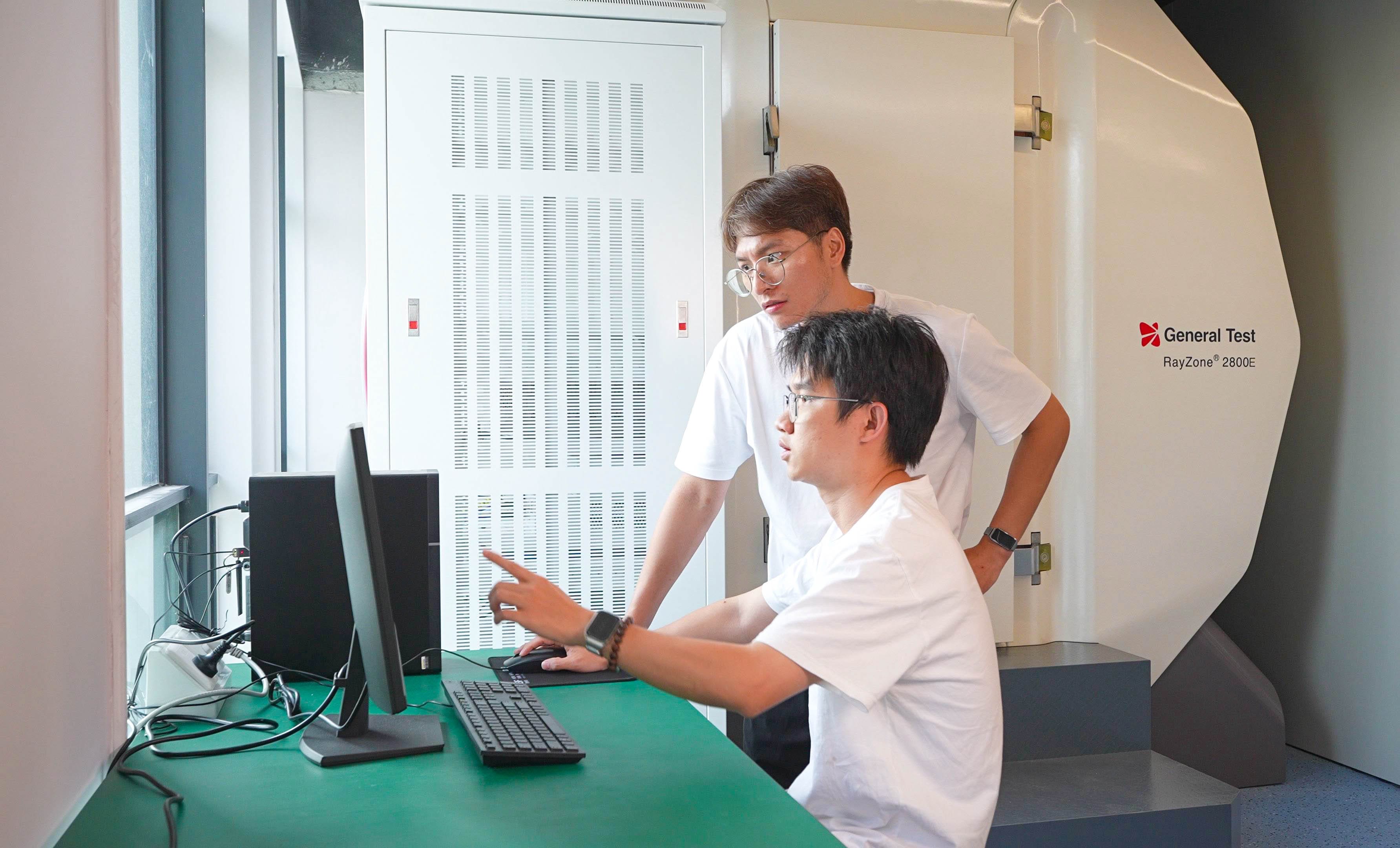
Keep one sheet per market with seven fields: the requirement, the issuing body, the reference number, the model and build covered, the issue date, the expiry date, and the internal owner who confirmed it. Add a status column so an expiring letter is visible before an event rather than during it. Refresh the file before each season and whenever a payment application or kernel is updated, because an approval tied to an older build stops describing the fleet the moment the firmware changes. Telpo's manufacturing quality controls include ISO 9001, a CNAS-accredited laboratory upgraded in 2025 to approximately 900 sqm across 12 testing zones, and 100% functional testing, which is the right basis for requesting test evidence alongside certificates.
FAQ
CE-certified POS Terminal manufacturers: what should buyers verify before a temporary-sales rollout?
A CE claim has to be read at the level of the directive and the model. For radio equipment in the EU, the relevant instrument is the Radio Equipment Directive 2014/53/EU, which addresses safety, health, electromagnetic compatibility, radio and environmental requirements. The Telpo evidence set reviewed here does include a CE RED type-examination certificate, B2407051, issued 17 July 2024 by Bay Area Compliance Labs Corp., but its scope names the T10 ticket validator rather than the P9. Buyers should therefore request the declaration and test documentation that names the exact handheld model and hardware revision, together with the RoHS and WEEE records for that same model.
Do certification requirements change between regions for the same handheld terminal?
Yes, and in three separate ways. Payment-scheme acceptance depends on the acquirer and the market — RuPay approval matters in India, Discover in the United States, PURE internationally. Radio and electromagnetic approvals are jurisdiction-specific, with CE RED governing EU radio equipment and FCC authorisation governing US transmitters. Fiscal recording rules are country-level, as Germany's KassenSichV shows. The hardware can be identical while the evidence file is not, so build one file per market even when a single fleet serves several events.
How should removable batteries be handled for air freight and multi-day events?
The P9 is documented with a removable battery and 12–16 hours of continuous operation. Because the battery detaches, it can be shipped, stored and swapped separately from the terminal, which changes both the transport plan and the spares plan. Confirm with your carrier and freight forwarder which battery documentation and packaging rules apply to your route and quantities, confirm the venue's rules for spare batteries on site, and size charging capacity to the number of stands. A removable battery only solves runtime if charged spares actually exist at the venue.
What has to be confirmed about receipt printing before deployment?
Three things: whether a printed receipt is legally required in that market, what content and language it must carry, and whether the printer specification matches the requirement. The P9 is documented with a built-in thermal receipt printer, and 58 mm receipt printing appears in Telpo's mobile merchant-acquiring application unit whose scope includes the P9. Ask for the printer specification of the exact variant — paper width, roll size and print speed — and run a paper-consumption test on a sample device across a realistic event shift before ordering consumables.
Should a buyer test a sample before committing to a multi-event rollout?
Yes, and the test should be structured around the file rather than the feel of the device. Telpo's stated terms allow samples to be ordered individually for standard models. Use the sample to exercise the payment mix, receipt output, battery endurance across a full shift, network behaviour under congestion and the operator workflow. Then compare the certificate numbers associated with the sample's firmware build against the letters in your evidence file — that comparison is where scope mismatches surface, and it is far cheaper to find them before a season than during one.
What lead time should be planned for event-season handheld POS orders?
Telpo states a lead time of 30 days or more, subject to negotiation, with stock orders at 3–7 working days and bulk standard orders at 15–25 working days, against a monthly capacity of approximately 150,000–180,000 units and an MOQ typically of 500–1,000 units. For event work, the number that decides success is not the first shipment but the spare pool, so order swap units and spare batteries in the same batch. If you are finalising a temporary-sales deployment, request a sample and a written compliance pack for your target markets together, so the device and its paperwork are reviewed in one pass — Telpo's product brochure is a practical starting point for the device side of that review.
Conclusion
The decision rule is simple to state and easy to skip: for every market an event touches, confirm four things against the exact model — payment approval, radio and electrical market access, battery transport, and receipt or fiscal output. The Telpo P9 shows why the exact-model framing matters. Its documented record covers EMVCo Contact Level 1 and Level 2 letters, Discover D-PAS Connect, PURE and RuPay approvals, plus RoHS and WEEE reports, and it describes a device with NFC and QR payment, a removable battery, 4G and Wi-Fi connectivity and a built-in thermal printer. The same record does not include CE RED, FCC, PCI PTS or fiscal module documentation for that model, so those items belong on the request list, not in the assumptions column.
Read every certificate as a scoped document: which model, which hardware revision, which kernel build, which market, and until when. A file built that way survives a firmware update, a venue change and a border crossing — and it lets a temporary sales operation open on day one instead of the day after the paperwork clears.
Have Questions or Need More Details?
Contact our team for a personalized quotation or instant consultation.
Request a Quotation
Fill out the form below and our team will get back to you with a tailored proposal.
WhatsApp Direct Chat
Prefer to chat in real-time? Message us on WhatsApp for instant assistance & quick answers.
- Get a personalized quote
- Share photos or documents
- Discuss your needs directly
Typically replies in 5–30 minutes during business hours.