
Retail Checkout Pain: Android POS Solves Queues, Cloud Fees, and Lag
A busy retail store feels its hardware limits at the checkout counter. Long queues, recurring cloud AI fees, and visible UI lag when POS, analytics, and inventory apps run together are not separate problems — they are three symptoms of the same underlying constraint: an underpowered terminal trying to run modern retail workloads through a cloud roundtrip.
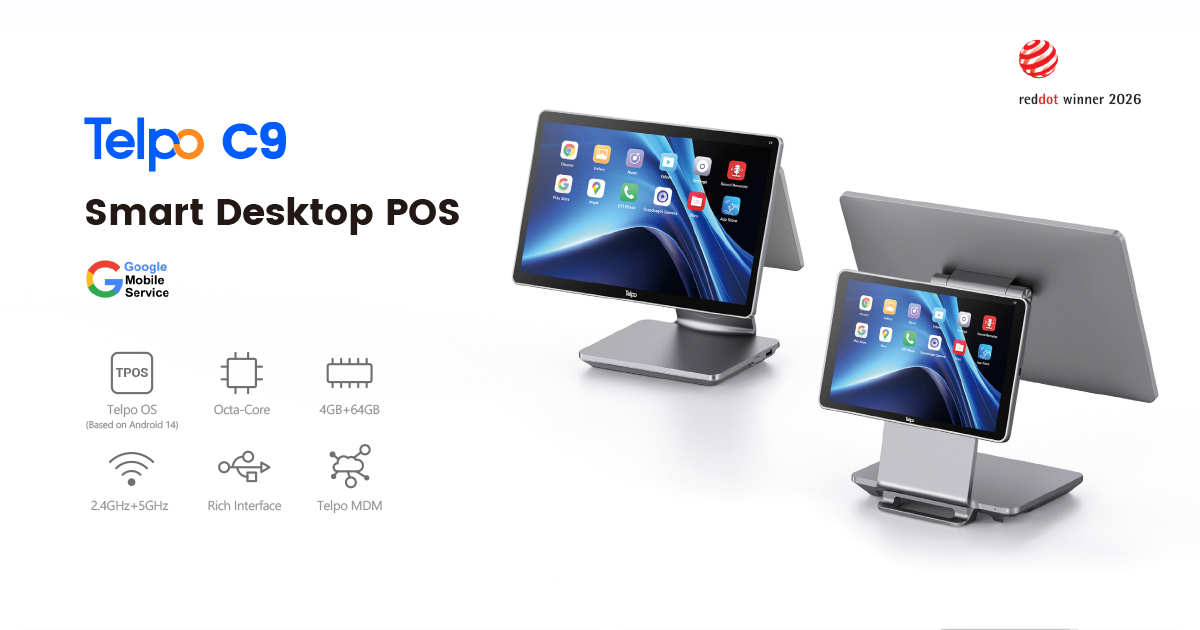
The short answer: On an Android POS terminal with on-chip AI, visual analytics run locally instead of in the cloud. The Telpo C9 carries 6–12 TOPS of on-chip AI, an 8-core processor, and either 4+64 GB or 8+128 GB of memory and storage. The result is 50–200 ms of saved latency per inference request, no recurring cloud-compute fee for local workloads, and enough headroom to run POS, inventory, and analytics apps concurrently without UI lag.
Problem Definition: Why Checkout Bottlenecks Compound
In a retail store, checkout speed is a throughput metric, not an aesthetic preference. Every extra second per transaction reduces the number of customers a lane can serve during a peak hour, and every stalled app on the terminal adds visible friction in front of the shopper.
Three workloads interact at the counter today:
- Queue throughput. Each transaction has to pass through payment authorization, receipt generation, and increasingly a visual check — scanning items, verifying age-restricted goods, or tracking shelf-to-register handoff.
- Visual AI costs. Loss prevention and customer analytics have been pushed to cloud inference on many POS deployments. That model works, but it imposes a network roundtrip per request and a recurring per-call cloud bill that scales with transaction volume.
- UI lag under multi-app load. Retail terminals increasingly host the POS application, an inventory sync client, and an analytics dashboard simultaneously. On a 4-core terminal with modest RAM, this shows up as UI stalls and app-swapping behavior that directly slows the cashier.
These three problems share a root cause: the terminal architecture was specified for single-task POS, not for the multi-app, on-device-AI workload that smart retail now requires.
Industry Background: Android Is Now the Default — But Specs Lag Behind
Android is no longer a niche choice for retail hardware. According to Counterpoint Research, Android-based POS terminals reached approximately 48% of global shipments in 2025. That shift makes Android POS terminal selection a mainstream procurement decision rather than a specialist one, and it also means the market is full of devices that look similar on the outside but differ sharply in processor count, on-chip AI capability, and memory configuration.
Smart retail workloads have moved in a direction that exposes those differences. Visual analytics — once a novelty — is now expected at checkout for loss prevention, queue monitoring, and customer flow analysis. Running that analytics stack on the terminal itself, rather than in the cloud, changes both the latency profile and the operating-cost profile of a store fleet. The question for buyers is no longer whether to run on-device AI, but whether the hardware on the counter can actually carry it.
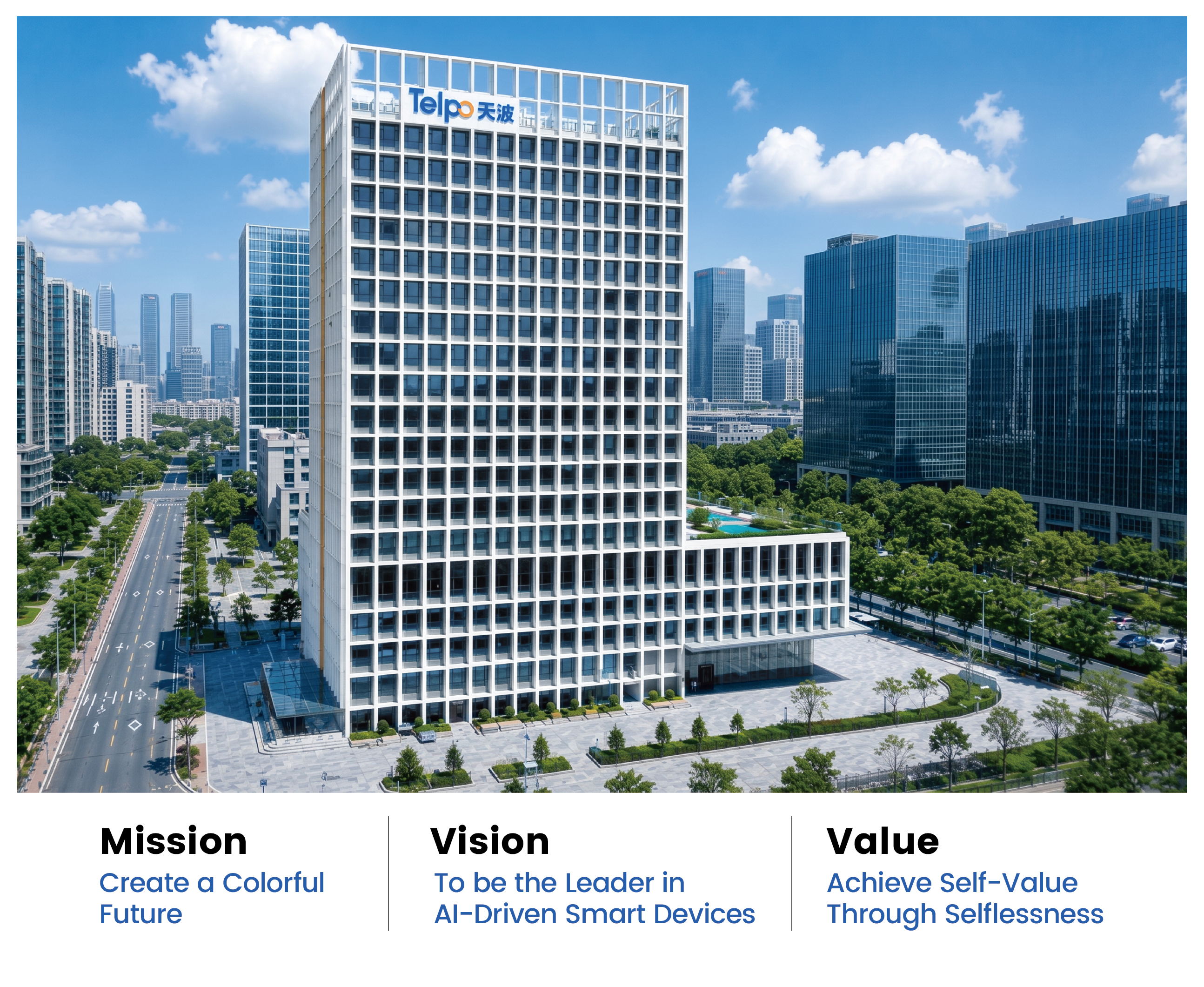
Telpo Technology Co., Ltd. is a smart terminal manufacturer founded in 1999 and headquartered in Foshan, China, operating across smart retail, smart payment, smart transportation, and biometric security segments. Its product portfolio includes Android POS terminals, self-service kiosks, ticket validators, biometric devices, and PDAs, and the company exports to more than 100 countries across Africa, the Middle East, Southeast Asia, Latin America, and Europe.
Detailed Solution: What On-Device AI Changes at the Checkout
The architectural fix for the three checkout pains is to move the visual analytics inference from the cloud to the terminal. The Telpo C9 Android POS terminal is built around that principle.
On-chip AI: 6–12 TOPS, local inference
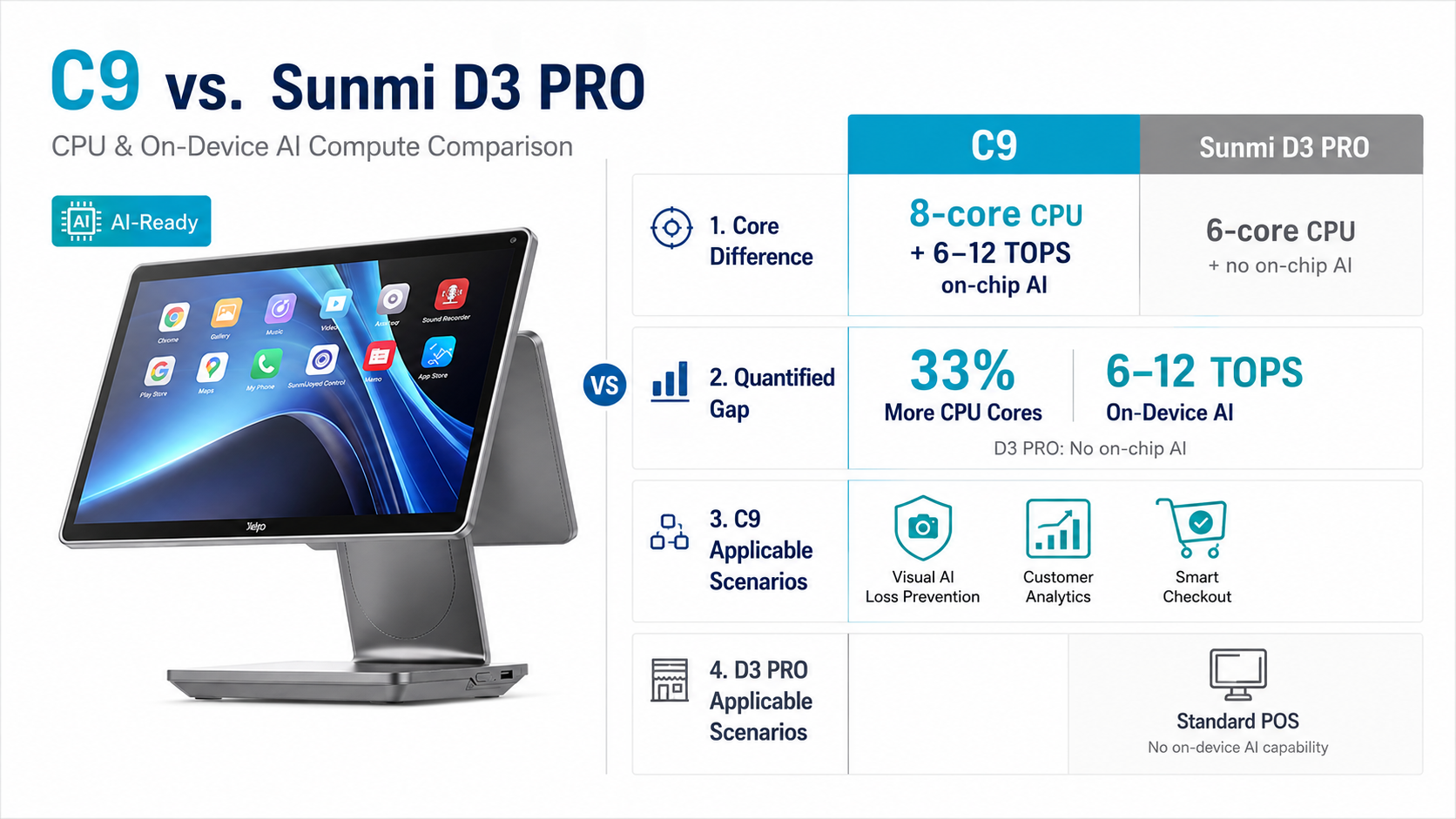
The C9 integrates 6–12 TOPS of on-chip AI compute. In practice, that means loss-prevention models, shelf-monitoring models, and customer-analytics models run on the device. The performance gap versus a cloud-dependent or AI-less terminal is measurable:
- Latency: roughly 50–200 ms saved per inference request compared with a cloud roundtrip.
- Cost: recurring cloud-compute fees for local AI workloads are eliminated, because inference does not leave the terminal.
- Reliability: visual analytics continue to function when network quality drops, because inference is not dependent on the cloud.
This is the point of comparison when a buyer is looking at a conventional POS with no on-chip AI. The Sunmi D3 PRO, for example, uses a 6-core processor with no on-chip AI. The C9's combination of 8 cores plus 6–12 TOPS of on-chip AI is what makes on-device visual AI workloads practical rather than aspirational.
8-core processing: multi-app checkout without UI lag
Checkout in a modern store is not a single application. It is the POS app, an inventory sync client, and an analytics dashboard running side by side. On a 4-core terminal — such as the iMin Swan-1 — these workloads can collide, producing UI stalls and a slower per-transaction time.
The C9's 8-core processor reduces that collision. The additional cores handle concurrent POS, inventory, and analytics apps without UI lag, which shortens per-transaction time and avoids the throughput bottleneck that lower-core configurations hit under multi-app load. In a store serving a high transaction volume, this is a direct improvement in checkout throughput rather than a cosmetic upgrade.
Memory and storage: 4+64 GB or 8+128 GB for offline AI cache
On-device AI needs somewhere to store its models, and rich retail media needs storage headroom. The C9 is offered in 4+64 GB or 8+128 GB configurations. This matters for two reasons:
- Offline AI-model cache. Cached models let the terminal keep running visual analytics without pulling the model from the cloud each time, which reduces bandwidth and sync cost and enables longer offline operation.
- Richer retail media. Larger storage ceiling supports product imagery, digital promotion, and customer-facing content on the same terminal that runs the POS.
The contrast with lower-storage alternatives is direct. The iMin Swan-2 is offered in 2+16 GB or 4+64 GB configurations. At the high end, the C9 offers 2x the RAM (8 GB vs. 4 GB); at the low end, it offers 2x the storage (64 GB vs. 16 GB). More RAM avoids app-swap stalls under multi-app load, and more storage supports offline AI-model cache and richer retail content. For a store that intends to run visual AI at the counter, this difference in memory ceiling is a real architectural constraint, not a spec-sheet detail.
Android 14: longer security-patch lifecycle for long deployments
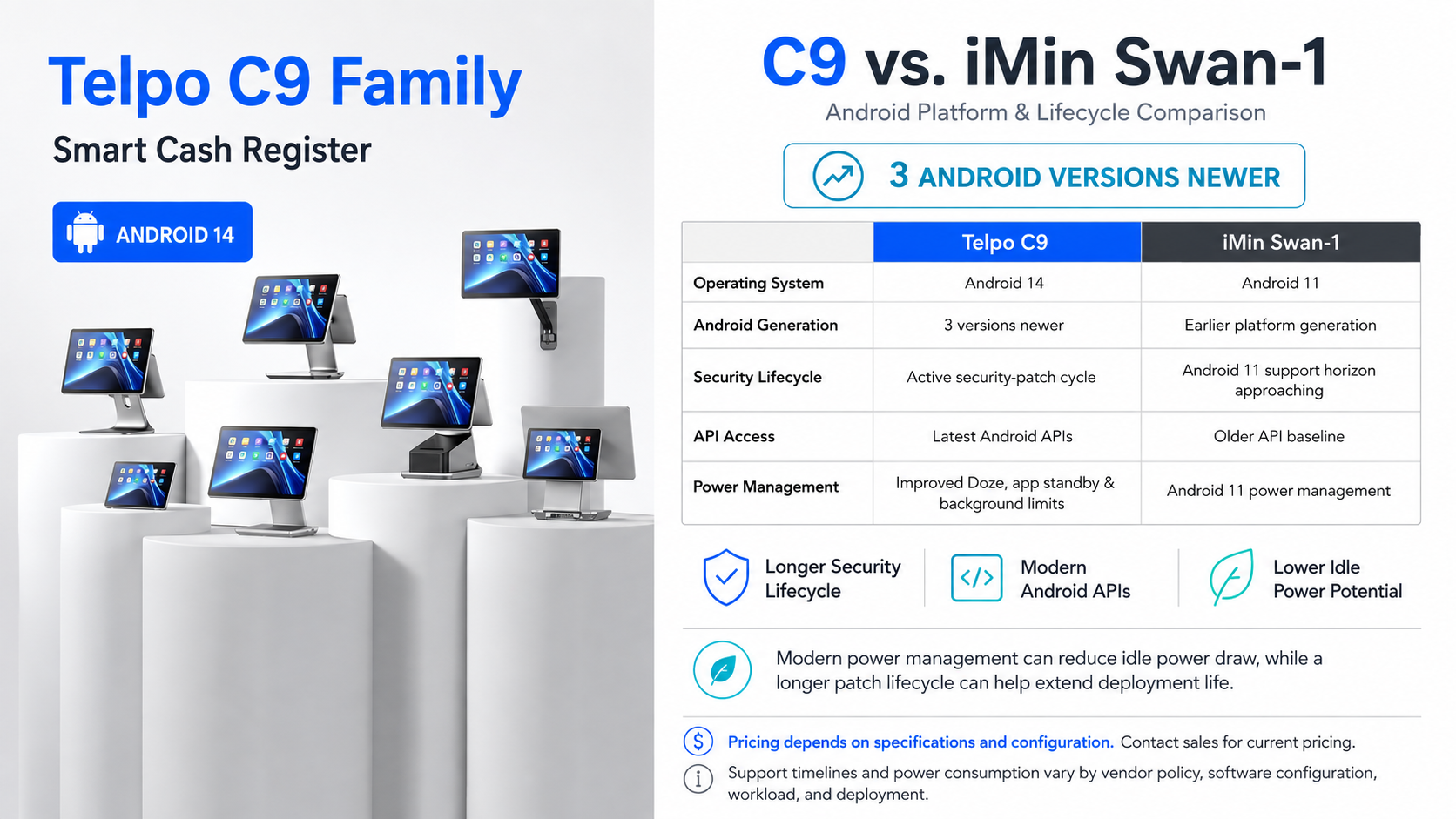
A retail terminal is usually deployed for years, not months. Longevity therefore depends partly on the operating system's security-patch cycle. The C9 runs Android 14, three Android versions newer than the Android 11 used by the iMin Swan-1. That gap matters on two dimensions:
- Security patching. The C9 sits on an active Android security-patch cycle, while the Swan-1's Android 11 lifecycle is approaching end-of-support.
- Power management. Android 14 brings improved power management — Doze, app standby, and background limits — compared with Android 11, lowering idle power draw and reducing forced-refresh pressure over the life of the deployment.
Step-by-Step Breakdown: How the C9 Resolves a Checkout Bottleneck
The fix is easier to understand as a sequence of operational steps than as a specification list.
- Capture the visual input locally. A camera or scanner at the checkout lane captures product or shelf imagery. On a cloud-dependent architecture, that image leaves the store and returns an inference result. On the C9, the image is processed on the device.
- Run inference on-chip. The C9's 6–12 TOPS of on-chip AI executes the visual model locally. A cloud roundtrip of 50–200 ms per request is eliminated because the request never leaves the terminal.
- Serve from the local model cache. With 64 GB or 128 GB of storage, the C9 can keep AI models cached offline. Model updates can be scheduled, and day-to-day inference does not depend on the network or on per-call cloud billing.
- Keep POS, inventory, and analytics running concurrently. The 8-core processor absorbs the combined load without UI stalls. This is the difference between a terminal that slows down under multi-app use and one that maintains checkout throughput.
- Manage the fleet centrally. Across a multi-store rollout, Telpo MDM — the manufacturer's proprietary device-management platform — provides centralized control over the terminal fleet, including remote control, device configuration, and personalization. Telpo OS, the manufacturer's independently developed operating system, handles device monitoring and management, which is the operational side of keeping a long-lived fleet stable.
The combined effect is that the three checkout pains — queues, cloud fees, and app lag — are addressed by architecture rather than by adding cloud services on top of the problem. A store that moves visual AI inference onto the terminal reduces per-transaction latency and removes a recurring cloud cost line from the fleet's operating budget.
Use Cases: Where On-Device AI Actually Pays Back
Loss prevention at the checkout lane
Visual loss-prevention models — detecting scan avoidance, bottom-of-basket losses, or unusual item handoff at the register — benefit from low-latency inference. When each check is served from the cloud, latency per request adds up across the lane. On-device inference on the C9 removes that roundtrip and keeps the check within the transaction rather than behind it.
Customer analytics in-store
Footfall counting, queue-length monitoring, and dwell-time analytics are typically modeled as periodic rather than real-time, but at scale the cloud bill for continuous inference becomes significant. Running these models on the C9 avoids recurring cloud-compute fees for local workloads and keeps analytics functioning during network interruptions.
Smart checkout and product recognition
Product recognition and smart-checkout workflows depend on a visual model being available at the point of decision. With 6–12 TOPS of on-chip AI and 4+64 GB or 8+128 GB of memory and storage, the C9 can hold the product catalogs, promotional media, and AI models required for a smart-checkout lane on a single terminal.
Multi-store retail media
Retail media on the checkout lane — digital promotion, customer-facing content, and product imagery — competes for the same storage as AI model cache. The C9's storage ceiling (up to 8+128 GB) supports richer media than lower-storage configurations, without forcing the store to choose between retail media content and AI model cache.
Comparison Table: C9 vs. Comparable Android POS Configurations
The following table uses only facts confirmed in the source materials. Where a source does not specify a dimension, it is marked — rather than inferred.
| Feature | Telpo C9 | Sunmi D3 PRO | iMin Swan-2 | iMin Swan-1 |
|---|---|---|---|---|
| Processor | 8-core | 6-core | — | 4-core |
| On-chip AI | 6–12 TOPS | No on-chip AI | — | — |
| Operating system | Android 14 | — | — | Android 11 |
| Memory & storage | 4+64 GB or 8+128 GB | — | 2+16 GB or 4+64 GB | — |
| Multi-app checkout | Concurrent POS + inventory + analytics | Standard POS | Budget deployments only | Single-task POS |
| Local visual AI inference | Yes — 50–200 ms saved per request vs. cloud roundtrip | No | — | — |
| Price | Quote by configuration | Quote by configuration | Quote by configuration | Quote by configuration |
Two observations from the table are worth flagging for buyers. First, the difference between the C9 and the D3 PRO is not just core count — the C9 has 33% more cores, but the decisive gap is the presence of 6–12 TOPS of on-chip AI versus none. Second, the memory and storage comparison against the Swan-2 is where the offline-AI and retail-media use cases either fit or do not fit: the C9 offers 2x the RAM at the high end and 2x the storage at the low end.
FAQ
What security and quality compliance standards apply to the C9 and its manufacturer?
The C9 runs Android 14, which sits on an active Android security-patch cycle — a meaningful difference from the approaching end-of-support for Android 11 configurations. At the manufacturing level, Telpo Technology Co., Ltd. holds ISO 9001 quality certification and operates a CNAS-accredited laboratory that performs 100% functional testing on all units. The manufacturer's payment terminal ecosystem includes PCI 6.x certification and EMVCo-certified contactless modules.
Can the C9 run POS, inventory, and analytics apps concurrently without lag?
Yes. The C9 uses an 8-core processor, compared with 4 cores on the iMin Swan-1 and 6 cores on the Sunmi D3 PRO. The additional cores handle concurrent POS, inventory, and analytics workloads without UI lag, which shortens per-transaction time and avoids the throughput bottleneck that lower-core configurations hit under multi-app load. The C9 also pairs this with 6–12 TOPS of on-chip AI and 4+64 GB or 8+128 GB memory and storage, which supports offline AI-model cache and richer retail media.
How does C9 pricing compare with comparable POS terminals?
C9 pricing depends on the specific parameters and configuration. Telpo quotes the terminal against the chosen memory and storage option (4+64 GB or 8+128 GB), quantity, and project-specific requirements; buyers should contact the sales team for current pricing rather than rely on a list figure. As a reference point for commercial-grade smart POS hardware, Counterpoint Research reports that the average selling price ranged from USD 120 to USD 850 in 2025.
Can I test the C9 before placing a bulk order?
Yes. Telpo accepts sample or trial-batch orders from 2–50 units. For OEM logo printing and custom packaging, 200+ units apply. Specific minimum order quantities depend on product type and should be confirmed with the Telpo sales representative before the order is placed.
What lead times and monthly capacity should a buyer expect for a long-term C9 supply partnership?
Telpo's monthly production capacity is approximately 150,000 to 180,000 smart terminals, with typical lead times of 3–7 working days for stock orders and 15–25 working days for bulk standard orders. Delivery terms include FOB, FCA, CPT, and CIF, and the manufacturer exports to more than 100 countries across Africa, the Middle East, Southeast Asia, Latin America, and Europe. Buyers planning a multi-store rollout can discuss C9 configuration and supply scheduling directly with Telpo by email at business@telpo.com or by WhatsApp at +86 18603080594.
Conclusion: Fix the Architecture, Not the Symptom
Checkout queues, recurring cloud fees, and UI lag on a busy retail floor are not independent problems to be solved with separate purchases. They are the visible result of running modern retail workloads — including visual AI — on hardware and an inference model that were not built for them.
The C9 addresses the root cause by moving visual inference onto the terminal. The 6–12 TOPS of on-chip AI processes visual analytics locally, removing the cloud roundtrip and its 50–200 ms per-request latency, and eliminating recurring cloud-compute fees for local workloads. The 8-core processor supports concurrent POS, inventory, and analytics apps without UI lag. The 4+64 GB and 8+128 GB memory and storage options leave room for offline AI-model cache and richer retail media. Android 14 provides a current security-patch lifecycle for long deployments. And for the fleet as a whole, Telpo's MDM platform supports centralized device management across multiple stores.
For a retail business deciding on its next POS terminal — and planning to run the same platform across multiple stores over several years — the choice is between a terminal sized for the workload or a terminal sized for a spec sheet. The C9 is designed for the former.
Next Step: Evaluate the C9 for Your Checkout Workload
Request a sample unit, a configuration-specific quote, or the full product brochure to review C9 specifications side by side with your current terminal.
📧 business@telpo.com | 📞 +86 757 86337898-324 | 📱 WhatsApp +86 18603080594
📄 Download the Telpo Payment & Retail Product Brochure (PDF)
Have Questions or Need More Details?
Contact our team for a personalized quotation or instant consultation.
Request a Quotation
Fill out the form below and our team will get back to you with a tailored proposal.
WhatsApp Direct Chat
Prefer to chat in real-time? Message us on WhatsApp for instant assistance & quick answers.
- Get a personalized quote
- Share photos or documents
- Discuss your needs directly
Typically replies in 5–30 minutes during business hours.