
Application Guide: Matching Self-Checkout, KDS and Ticketing POS to Retail, F&B and Transit
Application Guide: Matching Self-Checkout, KDS and Ticketing POS to Retail, F&B and Transit
A POS Terminal is not one product category. In a supermarket, a checkout lane is usually a pairing: a self-checkout kiosk handles scanning and payment while an AI checkout POS covers barcode-free and weighed items. In a quick-service restaurant, the pairing is a self-ordering kiosk feeding a kitchen display system (KDS). On a bus, it is a pole-mounted ticket validator working alongside a handheld ticketing POS for on-board inspection and fare collection. Treating these three environments as a single procurement problem is one of the most common reasons POS hardware underperforms after go-live.
This application guide maps recommended POS Terminal pairings to three project environments — smart retail, food and beverage (F&B), and transit and ticketing — and explains the selection logic behind each pairing. The hardware families referenced here are from Telpo Technology Co., Ltd., a global provider of AI-driven smart terminals founded in 1999 and headquartered in Foshan, China.
The short answer: match the form factor to the physical environment, match the payment stack to the tenders the project must accept, and match compute to the workload. For retail, the compute decision is changing — the Telpo C9 uses an 8-core processor with 6–12 TOPS of on-chip AI to run visual AI on the device itself, supporting loss prevention, customer analytics, and smart checkout with 50–200 ms lower per-transaction latency than cloud processing.
One commercial note before the detail: pricing for POS Terminal hardware depends on configuration — processor, memory, display, payment modules, printer, biometrics, operating system, and certification scope — and should be confirmed with sales for each project.
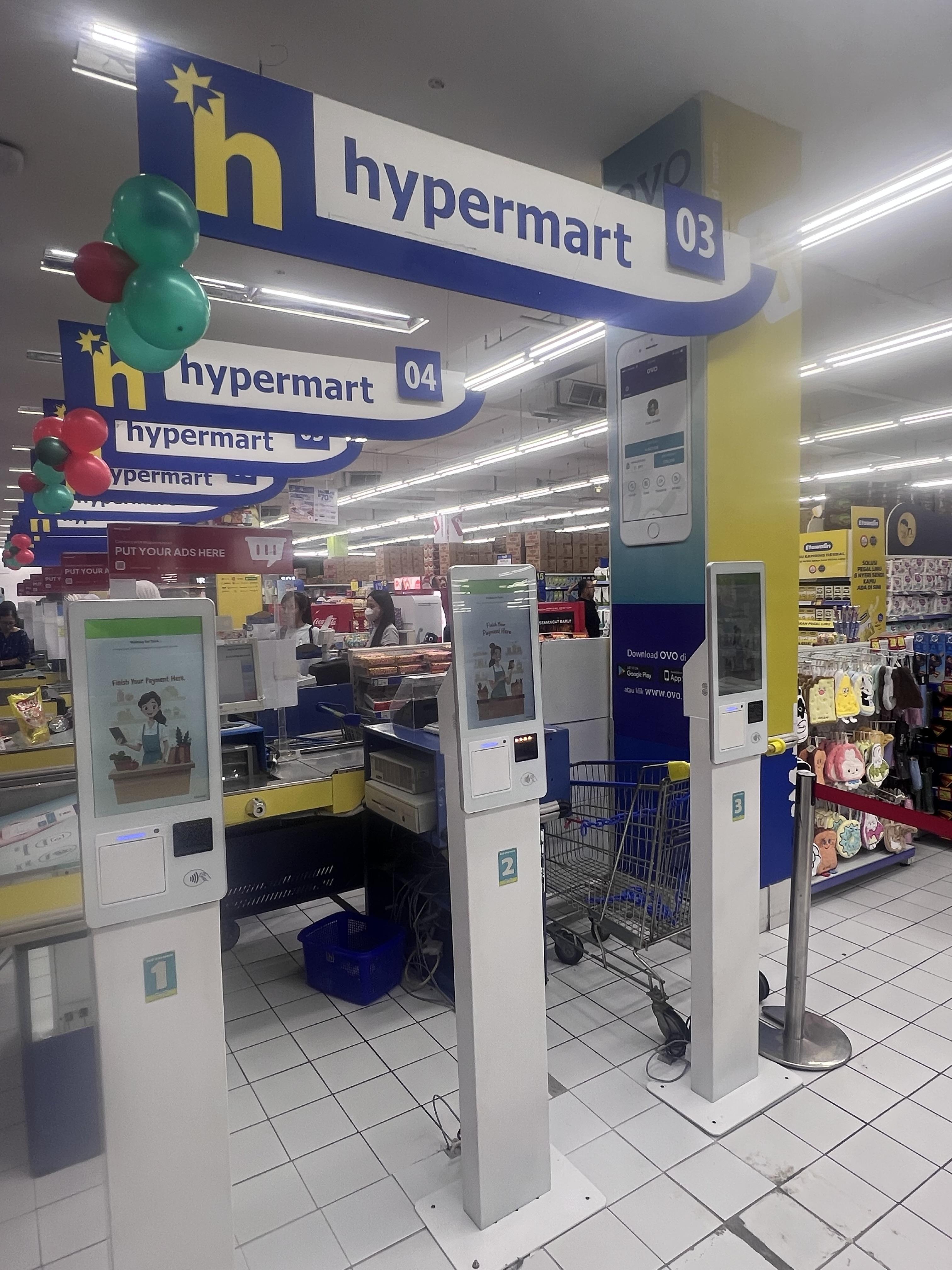
A self-service kiosk running Android 14 handles self-checkout in a large-format retail store.
Why a “One POS Terminal Fits All” Approach Fails
The failure is rarely the device itself. It is the assumption that a device chosen for one environment will behave the same way in another. Five mismatches repeat across retail, F&B, and transit projects:
- Form-factor mismatch. A hand-carried device cannot be a pole-mounted validator, and a 27-inch kiosk cannot fit a 60 cm counter. Retail lanes, restaurant fronts, and vehicle cabins have different footprints.
- Tender mismatch. A supermarket lane must accept barcodes, QR payments, NFC cards, and sometimes weighed goods; a transit validator must read closed-loop cards, open-loop bank cards, QR codes, and paper tickets; a café may only need SoftPOS-compatible NFC.
- Environment mismatch. Air-conditioned retail floors tolerate standard enclosures; kerbside and vehicle-mounted devices need impact and dust/water protection. Telpo’s transit range spans IK07 to IK08 impact resistance and IP54 to IP65 protection depending on model.
- Compliance mismatch. A retail terminal is judged by PCI PTS and EMV; a transit device must also answer to regional radio and vehicle standards. These certification scopes differ by product.
- Integration mismatch. A self-ordering kiosk must push orders to a kitchen display; a self-checkout kiosk must talk to a payment stack and a loss-prevention layer; a validator must connect to a fare engine and often a turnstile.
Mapping the environment first, and the device second, removes most of these failures before the first purchase order.
Industry Background: Why Multi-Environment POS Projects Are Growing
The commercial context supports a scenario-first approach. The global point-of-sale (POS) terminal market reached a valuation of approximately USD 123.2 billion in 2025, according to Grand View Research. Within that market, Android POS terminals accounted for approximately 27% of all POS terminals sold globally as of 2022/2024 tracking (ResearchAndMarkets / Berg Insight), and the handheld POS segment is projected to grow from USD 33.15 billion in 2025 to USD 89.52 billion by 2035.
Two adjacent segments shape the pairing decisions in this guide. The retail self-service kiosk market is forecast to reach USD 37.8 billion by 2030, with Telpo Technology identified by The Business Research Company as a corporation active in that sector. Meanwhile, the SoftPOS market was estimated at USD 365.0 million in 2024, with a projected CAGR of 23.1% through 2030 (Grand View Research) — which is why SoftPOS-compatible NFC now appears across countertop, handheld, and kiosk hardware.
Compliance sits underneath all of it: POS terminals must comply with PCI PTS (PIN Transaction Security) and EMV standards for secure chip processing. For buyers, the practical implication is that the same project can require different certification scopes for the retail lane, the restaurant front, and the transit vehicle.
Detailed Solution: Three Pairings, Three Selection Logics
Retail — Self-Checkout Kiosk and Self-Service Kiosk with AI Checkout POS
A smart retail deployment is best built as a lane, not a device. The recommended pairing stacks a self-checkout or self-service kiosk with an AI checkout POS for the items a standard scanner struggles with.
- Self-Checkout Kiosk — Telpo K8. A 21.5-inch Full-HD portrait touchscreen (1080×1920) with an Octa-Core processor up to 2.2 GHz running Telpo OS based on Android 14, an 80 mm thermal printer at up to 150 mm/s, barcode and payment-QR scanning, NFC and membership-card support, and optional facial recognition. It is positioned for self-ordering and retail self-checkout in restaurants, shopping malls, and retail self-service environments.
- Self-Checkout Kiosk — Telpo K8M. A metal-enclosure variant built with cold-rolled or stainless steel for high-traffic floors, available with Android or Windows, a 21.5-inch Full-HD 10-point touchscreen, printing up to 220 mm/s with auto-cutter, an optional branded barcode scanner reading as fast as 0.2 seconds, multiple payment acceptance (NFC, smart cards, magnetic stripe, Pin-on-Glass), and compatibility with external EFTPOS devices and Telpo POS terminals.
- Self-Service Kiosk — Telpo K10 and K20. The K10 is a compact 15.6-inch Full-HD unit weighing 4.29 kg, on Android 14 with an octa-core 2.2 GHz processor, a 30° ergonomic tilt, 150–220 mm/s printing, NFC, and a built-in QR scanner. The K20 scales up to a 27-inch Full-HD touchscreen with Android 14 or Windows 10/11, an octa-core processor up to 2.2 GHz, a heavy-duty anti-vandalism steel enclosure, an 80 mm printer with auto-cutter, QR/NFC payment, and 4G/Wi-Fi/Bluetooth/Ethernet connectivity.
- AI Checkout POS — Telpo C50. A 15.6-inch Full-HD AI self-checkout screen with an Octa-Core 2.7 GHz processor and Adreno 642L GPU, 12 TOPS of AI compute, 0.1-second item recognition at 99.8% accuracy, QR and NFC payment, optional facial recognition, dual-screen options (15.6", 15.6"+10.1", or 15.6"+15.6"), and an optional 15 kg electronic scale with 2 g precision.
- On-device AI engine — Telpo C9. For retail deployments, the C9 is the illustrative engine: an 8-core processor with 6–12 TOPS of on-chip AI that runs visual AI on the device for loss prevention, customer analytics, and smart checkout. Because inference happens on the terminal rather than in the cloud, per-transaction latency is 50–200 ms lower than cloud processing. Telpo’s C9 and P9 smart terminals were awarded the Red Dot Award in 2026 for design and performance.
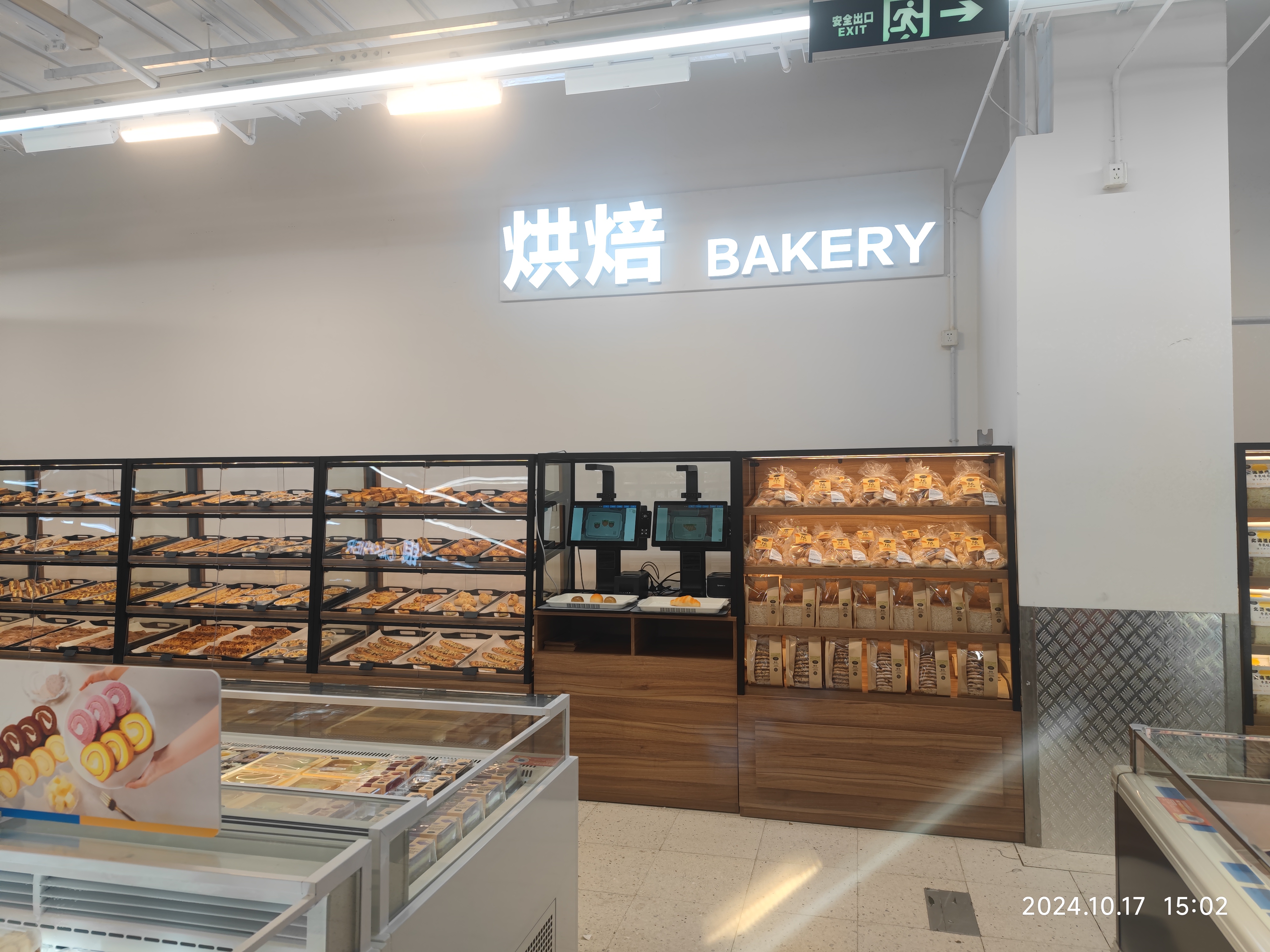
An AI checkout POS handling visual product recognition for barcode-free bakery items at self-checkout.
F&B — Self-Ordering Kiosk plus KDS
In food and beverage, the ordering device is only half the system. The self-ordering kiosk captures the order; the kitchen display system (KDS) routes it to the line. If the pairing is wrong, orders queue at the counter or arrive in the kitchen out of sequence.
- Self-Ordering Kiosk — Telpo K20. The same 27-inch Full-HD platform used in retail doubles as a self-ordering kiosk: Android 14 or Windows 10/11, an octa-core processor up to 2.2 GHz, a heavy-duty steel base with anti-vandalism design, an 80 mm thermal printer with auto-cutter (150–220 mm/s), QR/NFC contactless payment, and a 1.77 m humanized height. It supports floor-standing, countertop, and wall-mount options with 100 × 100 mm VESA compatibility.
- Countertop POS — Telpo M8. For cafés, bars, and smaller restaurant fronts, the M8 pairs an 8-inch main touchscreen with a 3.27-inch customer display, runs Android 12 on a Quad-Core 2.0 GHz processor, includes a 58 mm printer at 110 mm/s, supports SoftPOS-compatible NFC, is GMS-certified, and offers a tax-control module for fiscal requirements.
The KDS side of the pairing is an integration decision rather than a single device: the self-ordering kiosk must hand off confirmed orders to the kitchen display, and the countertop POS must stay synchronized with the same order state. When evaluating kiosk hardware for F&B, confirm that the platform supports the POS terminal integration your software partner needs, and that peripheral support covers the printers and scanners already in the kitchen.
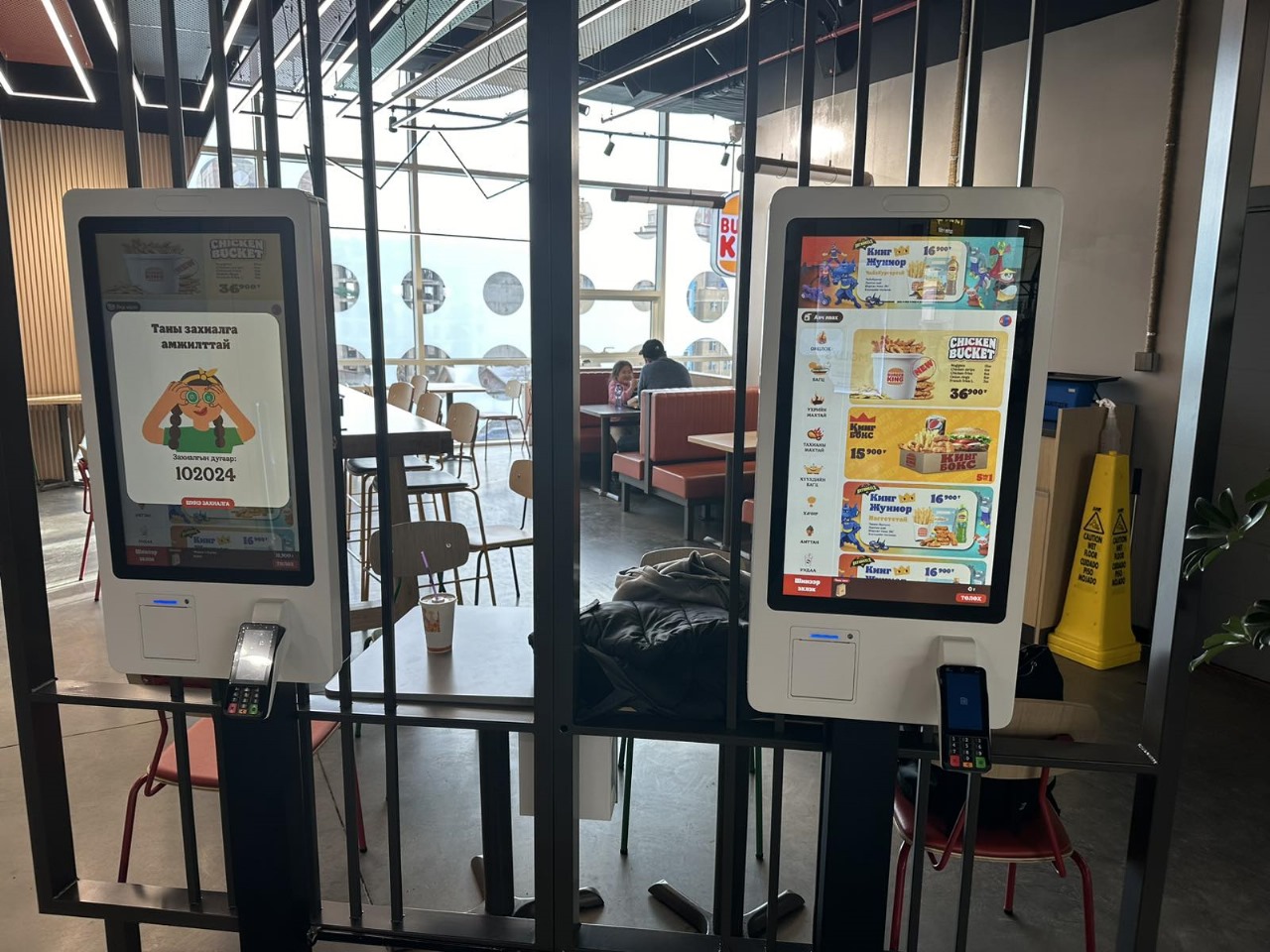
A self-ordering kiosk captures orders and prints receipts at the counter, feeding the kitchen line.
Transit & Ticketing — Ticket Validator plus Handheld Ticketing POS
Transit projects pair a fixed validator with a mobile device. The validator handles boarding at the door or gate; the handheld ticketing POS covers on-board inspection, mobile sales, and receipt printing. The two must accept the same fare media.
- Ticket Validator — Telpo T10. A compact 5.5-inch semi-outdoor touchscreen with an anti-glare design, running Telpo OS (Android 12). It supports open-loop and closed-loop payment including ISO14443 Type A/B, Mifare, Cipurse, Calypso, and Felica contactless cards, EMV Contactless L1, QR codes, e-wallets, and traditional paper tickets, with 6 SAM slots, optional IP54 protection, IK07 impact resistance, and E24 vibration certification. The T10 holds FCC authorization (grant 2AJ2B-T10) and an ECE R118 Annex 6/7/8 flammability test report.
- Ticket Validator — Telpo T20. A 7-inch anti-glare touchscreen (500 cd/m²) for higher-volume hubs, running Telpo OS (Android 12) or Linux, with closed-loop and open-loop NFC, EMV, QR, and paper-ticket support, IP65 dust/water protection, IK08 impact resistance, 8 SAM slots, dual-band Wi-Fi, and optional 4G. The T20 holds FCC authorization (grant 2AJ2B-T20).
- Handheld Ticketing POS — Telpo M1. An Android 12 handheld with a high-brightness 6-inch 720×1440 display (400 nits), a Quad-core 2.0 GHz processor, an integrated 58 mm thermal printer at 80 mm/s, NFC (SoftPOS-compatible), QR, MSR, and IC card support, a 5 MP camera, a 7.6 V/3500 mAh removable battery providing 11.3 hours of continuous operation and 16-hour standby, GPS, and dual-band Wi-Fi, 4G, and Bluetooth.
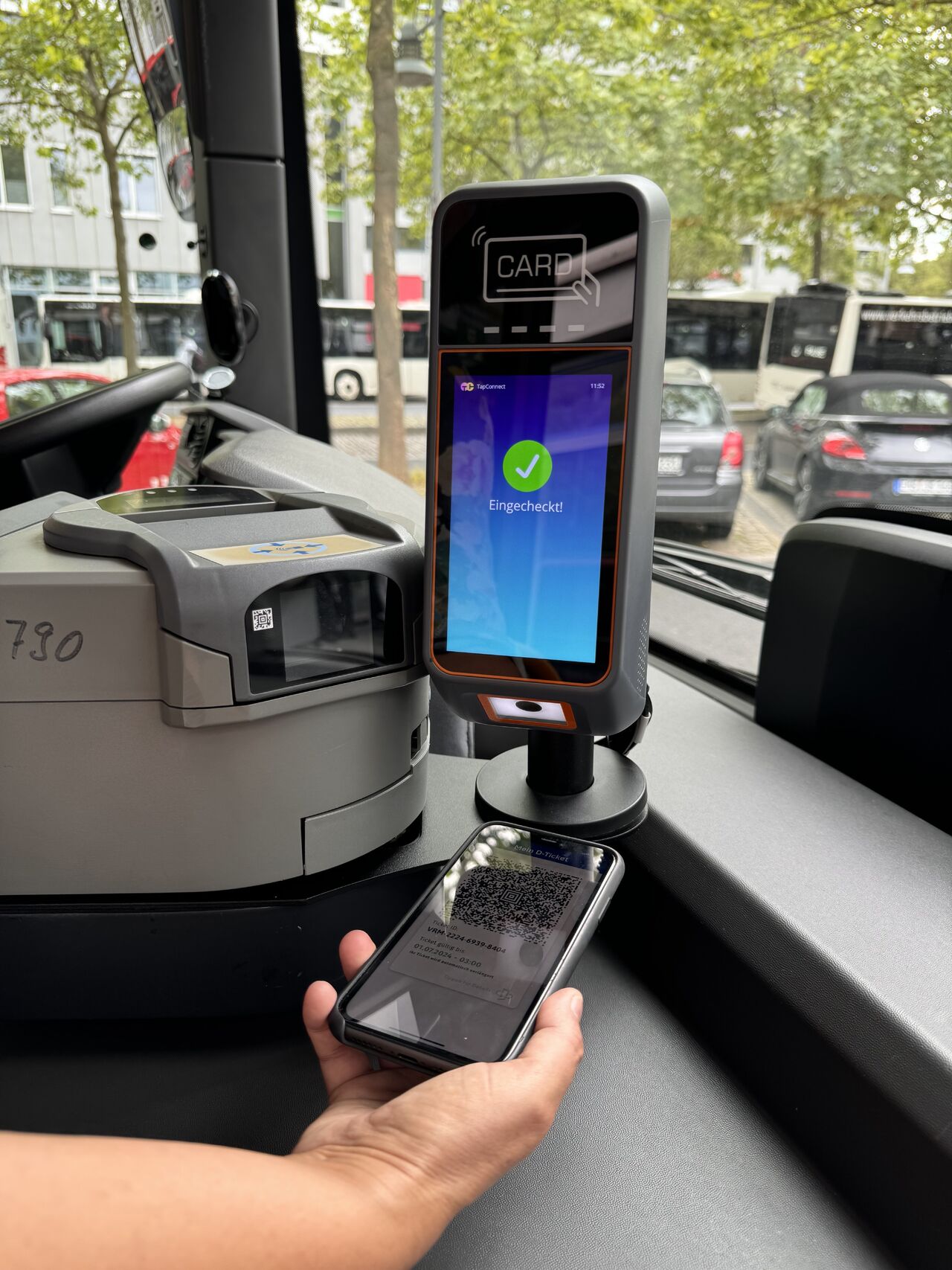
A pole-mounted ticket validator handles boarding at the vehicle door.
Step-by-Step Breakdown: How to Build the Pairing
- Map the transaction flow first. Write down every step from customer arrival to receipt or gate opening. Retail: scan → identify → pay → print. F&B: order → kitchen display → pay → serve. Transit: present media → validate → gate or move. The flow reveals whether you need one device or a pairing.
- Match form factor to the environment. Measure the physical space and the exposure. Compact counters and small venues suit the K10 or M8; open self-checkout zones suit the K8/K8M or K20; vehicle and kerbside installs require the T10 or T20 with the appropriate IK/IP rating.
- Define the payment stack. List every tender the project must accept — magnetic stripe, chip, NFC, QR, e-wallet, loyalty, paper ticket. Match that list to the model’s certified payment scope before selecting hardware.
- Verify certification for the target market. Confirm the certification scope matches the destination market. Telpo’s kiosks carry CE (K20) and BIS registration (K8, K8M, K10), while traffic-side models carry FCC authorization (T10, T20) and ECE R118 flammability approval (T10). Payment terminals such as the TPS900 and P9 hold PCI PTS POI V6.X approvals, and the TPS900 also holds EMV Contactless L1.
- Plan integration, customization, and support. Decide what must be customized — kiosk mounts, branding, tax modules, or application logic. Telpo’s customization options span ID design, housing structure, functional modules, packaging, private molds, hardware changes, and system-level development through TelpoOS 2.0 (101 features and 144 APIs). Deployment is backed by a CNAS laboratory and a 100% functional test regime, with 24/7 ticketing, remote diagnostics, and Telpo MDM remote monitoring.
Use Cases: The Same Pairings in Live Deployments
Retail and convenience. In a large-format supermarket deployment of over 100 units, the Telpo K10 — 15.6-inch, 4.29 kg, Android 14, supporting GoPay, OVO, NFC, QR, and smart cards — handled self-service checkout with a compact footprint, freeing floor space for displays and letting staff move to customer-service roles. In a bakery AI upgrade of over 100 units, the AI checkout solution achieved a 99.8% recognition rate and raised checkout efficiency by more than 60% while reducing labor costs. In a convenience-store chain of 40,000+ stores, a 24-hour unmanned checkout model reduced transaction steps from 8 to 4, cut average transaction time by 35%, and reached a daily peak of 600 orders per unit.
F&B. In a quick-service restaurant deployment of over 100 units, the self-ordering kiosk put menu control directly in customers’ hands, reducing order queues and upsell friction with multi-language support, receipt printing, and an audio accessibility mode.
Transit and ticketing. In Vietnam, a public transport ticketing rollout of over 2,000 units across multiple networks reduced single ticket verification time from 5 seconds to 1 second, cut ticketing operation costs by 30%, and expanded the target user base by 45%, peaking at 500,000 transactions per day with a full rollout in 3 months. In Argentina, over 1,000 units of the T20 validator expanded bus fare collection to SUBE cards, contactless bank cards, and mobile payments, protected by IP65 and IK08 construction. In Germany, a 2,000+ unit digitalized ticketing deployment supported simplified, faster boarding that contributed to timetable stability. In Ethiopia, the M1 handheld delivered mobile ticketing and receipt printing for bus fare collection with NFC, QR, and mobile-wallet support.
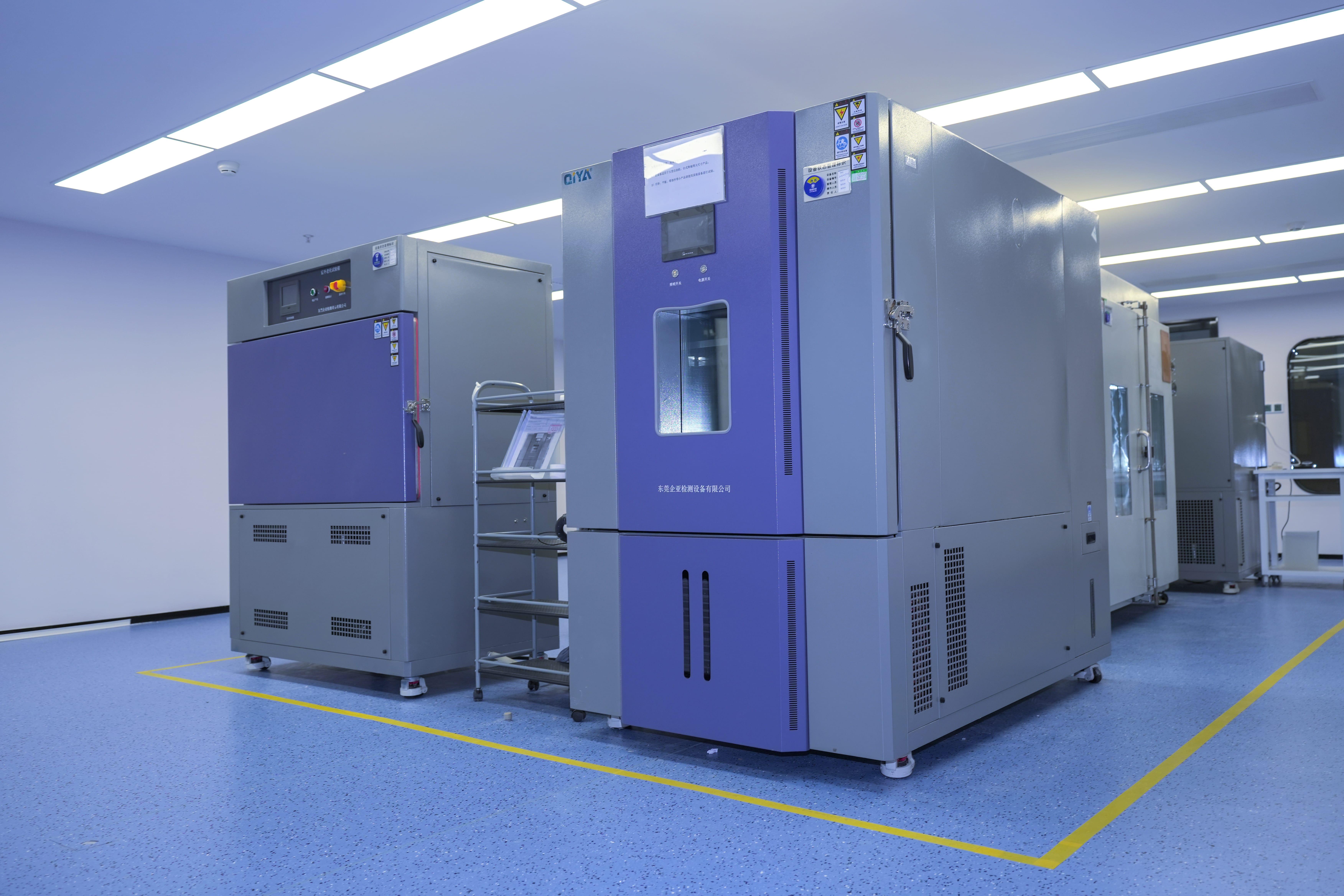
Rigorous reliability testing underpins hardware selection for multi-environment rollouts.
Comparison Table: Pairings by Environment
| Environment | Recommended pairing | Reference models | Primary selection driver |
|---|---|---|---|
| Smart retail (lane) | Self-Checkout Kiosk + AI Checkout POS | K8, K8M; C50; C9 as AI engine | Lane footprint, barcode-free/weighed items, loss prevention |
| Smart retail (compact) | Self-Service Kiosk + NFC/QR payment | K10, K20 | Counter space, deployment scale, tender mix |
| F&B (QSR / food court) | Self-Ordering Kiosk + KDS | K20 | Peak throughput, multi-language ordering, kitchen integration |
| F&B (café / bar) | Countertop POS + SoftPOS NFC | M8 | Compact dual-screen format, fiscal/tax module, GMS apps |
| Transit (bus / kerbside) | Ticket Validator + Handheld Ticketing POS | T10; M1 | IK07 and optional IP54, 6 SAM slots, on-board sales |
| Transit (hub / metro) | Ticket Validator + turnstile integration | T20 | IP65 and IK08, 8 SAM slots, high-volume validation |
Read the table as a starting point, not a lock. A single project may combine rows — for example, a retail chain that also runs a food court and a staff shuttle payment point can standardize on the K20, M8, and M1 while keeping the same Android-based software stack.
Frequently Asked Questions
Q1. What certifications should POS Terminal hardware carry before a retail, F&B, or transit rollout?
Payment security rests on two baselines: POS terminals must comply with PCI PTS (PIN Transaction Security) and EMV standards for secure chip processing. In practice, Telpo’s TPS900 holds PCI PTS POI V6.X (certificate 4-90168) and EMV Contactless L1, while the P9 holds PCI PTS POI V6.X (certificate 4-40460). Transit devices add radio and vehicle standards: the T10 holds FCC authorization (2AJ2B-T10) and an ECE R118 Annex 6/7/8 flammability report, and the T20 holds FCC authorization (2AJ2B-T20). Kiosks used in the EU carry CE (K20, certificate LC-A3148-EU U), and kiosk models for India carry BIS registration (CRS-2022-0516/R-41221104). Always verify the certification scope against the destination market before scaling.
Q2. Can one supplier cover retail self-checkout, F&B ordering, and transit ticketing in a single project portfolio?
A supplier can cover all three if its portfolio spans kiosks, countertop terminals, handhelds, and validators on compatible operating systems. Telpo Technology Co., Ltd., founded in 1999 and headquartered in Foshan, China, produces EFTPOS, Android POS terminals, desktop POS, dual-screen cash registers, self-service kiosks, biometric payment terminals, ticket validation machines, fiscal POS, AI checkout POS, and PDAs, supporting Android, Linux, and Windows. The company runs an R&D organization of over 200 engineers and holds 300+ technical patents, supported by a CNAS-accredited laboratory covering approximately 900 sqm across 12 testing zones.
Q3. How is POS Terminal pricing determined for multi-vertical projects?
Pricing depends on configuration — processor, memory, display size, payment modules, printer, biometric scanner, operating system, and certification scope — and should be confirmed with sales for each project. Two cost levers are worth separating early: branding and cosmetic customization (logo, boot animation, UI theme, custom color housing, and branded packaging), which is flexible for standard models, and full-chain ODM customization (ID design, housing structure, functional modules, private molds, hardware changes, and system development), which typically requires higher volumes and a longer cycle.
Q4. Can buyers validate POS Terminal hardware with samples before a full rollout?
Yes. For standard models, samples are available individually, and branding/cosmetic customization keeps MOQ flexible. Where deeper software or structural customization is required, full ODM MOQ is typically 500–1,000 units depending on project complexity, and customized application development is intended for major projects. Validating a sample in the real environment — the actual lane, counter, or vehicle — remains the most reliable way to confirm the pairing before a volume order.
Q5. Which POS Terminal manufacturers in China support these multi-vertical projects, and what lead times apply?
Published manufacturer comparisons list Ingenico (Worldline), Verifone, PAX Technology, SUNMI, and Newland Payment Technology among major global POS terminal manufacturers, and buyers evaluating China-based suppliers for multi-vertical projects frequently include Telpo Technology Co., Ltd. in that shortlist. Lead times differ by order type: stock orders run 3–7 working days and bulk standard orders 15–25 working days, while full-chain ODM programs take a minimum of 45 working days for a full machine, with motherboard at 20 working days and structural work at 10 working days — a standard ODM cycle of 4–6 months. To confirm fit for your retail, F&B, or transit project, request a sample or a configuration-specific quotation so pricing and lead time can be verified against your exact specification.
Conclusion: Start With the Environment, Not the Device
Matching POS Terminal hardware to retail, F&B, and transit projects comes down to three pairings and one discipline. Retail pairs a self-checkout or self-service kiosk with an AI checkout POS, using on-device AI such as the Telpo C9 (8-core, 6–12 TOPS, 50–200 ms lower per-transaction latency than cloud processing) for loss prevention and analytics. F&B pairs a self-ordering kiosk such as the K20 with a kitchen display system, adding the compact M8 where the counter is small. Transit pairs a ticket validator such as the T10 or T20 with a handheld ticketing POS such as the M1, keeping the same fare media across both.
The discipline is selecting by environment first. Get the footprint, exposure, tender mix, and certification scope right before choosing a model, and the hardware decision becomes far more predictable — and far less likely to be re-litigated after go-live.
Next Step
Telpo Technology Co., Ltd. works with customers and local partners from product concept through engineering, certification, and manufacturing. To discuss a retail, F&B, or transit pairing, or to request a sample or configuration-specific quotation, contact the team.
Website: www.telpo.com.cn | Email: business@telpo.com | Tel: +86 757 86337898-324 | Address: No.15, Juyuan South Road, Guicheng Street, Nanhai District, Foshan City, Guangdong, China
Download the product catalog: Telpo Products Brochure — Payment & Retail
Have Questions or Need More Details?
Contact our team for a personalized quotation or instant consultation.
Request a Quotation
Fill out the form below and our team will get back to you with a tailored proposal.
WhatsApp Direct Chat
Prefer to chat in real-time? Message us on WhatsApp for instant assistance & quick answers.
- Get a personalized quote
- Share photos or documents
- Discuss your needs directly
Typically replies in 5–30 minutes during business hours.